aqm
Air Quality Management
Dr. Kulsum Ahmed ·
← Unveiling Pakistan's Air Pollution
Lessons from global experience for an effective AQMS
It’s a continuous journey, not a one-time fix: As London’s multidecade story shows, air quality management is an ongoing process of adaptation as cities grow, economies change, and new pollution sources emerge.
Good data is the starting point: Successful turnarounds, like Mexico City’s, began with a rigorous, scientific effort to collect credible data, identify the most harmful pollutants, and pinpoint their primary sources before formulating a plan.
Collaboration is non-negotiable: Air pollution does not respect administrative boundaries. Effective management requires a coordinated “airshed” approach, bringing together different government departments, provincial and federal authorities, and the public to tackle the problem collaboratively.
The solutions to air pollution are well-known, yet the air in our cities remains toxic. This paradox reveals a deeper truth: clean air is not the result of a single policy or a new technology, but of a robust, adaptive, and relentless system of management. Kulsum Ahmed draws on decades of global experience—from the smog of London to the crises in Mexico City and Delhi—to outline the essential architecture of an effective Air Quality Management system. This chapter provides a blueprint for moving beyond reactive, piecemeal efforts to build the lasting institutional capacity Pakistan needs to secure a breathable future.
Solutions on how to tackle specific sources of air pollution can be found throughout this report and in many other resources; indeed, a quick online search will instantly produce a lengthy list. So, technical solutions abound. Yet, the journey to achieving and sustaining cleaner air is rarely straightforward. This is because one-off solutions typically yield only partial or temporary results. Ultimately, for lasting improvement, a comprehensive Air Quality Management (AQM) system needs to be put in place, with key attributes for success.
Successful AQM should, firstly, be conducted in a continuous, stepwise, and scientifically robust manner. Secondly, it must be designed to strategically reduce specific air pollutants that are known to adversely affect public health. Thirdly, and crucially, it must take into account the societal context, including the trade-offs that communities and policymakers are willing and able to make in the pursuit of cleaner air.
How then can Pakistan approach this complex challenge? This chapter draws on important lessons from diverse AQM experiences around the world to provide guidance on what an effective AQM system could look like for Pakistan.
A continuous journey: lessons from London’s long smog
London was a city with highly polluted air in the 1940s and 1950s, suffering from “pea soup fogs” that were so bad that one could not see through them—rather like the situation in Lahore during winter. Prominent figures like Prime Minister Winston Churchill used to blame these debilitating fogs—which led to traffic accidents, business closures, and significant impacts on health and productivity—primarily on adverse weather conditions. However, this reflectedan incomplete understanding; a significant part of air pollution was attributed to the burning of coal in individual homes for cooking and heating, as well as by industries and power stations.1
A particularly severe episode, now infamously known as “The Great Smog of London”, occurred in mid-December 1952. Official estimates placed the number of resulting deaths at over 4,000, with more than 100,000 people falling ill due to acute respiratory illnesses. More recent estimates put the number of dead at 12,000. Four years later, following public debate and increased awareness of the effects of air quality on health and national productivity, the United Kingdom passed its first Clean Air Act in 1956. This put in place a number of measures to reduce air pollution, and was a milestone in initiating a national dialogue on environmental regulation and public health.
Fast forwarding to today, while London’s air quality is significantly better than it was in the 1940s and ’50s, it still faces challenges, particularly with levels of PM2.5—the pollutant most detrimental to health—often exceeding the World Health Organization’s (WHO) 2021 guidelines. Today, however, the primary sources of air pollution have shifted. With a vastly increased population, the expanded physical size of the city, and a larger vehicle fleet, the major contributor to London’s remaining air pollution is now personal car usage, despite the city’s extensive public transport system. Hence, congestion charges, dedicated bike lanes, and capped maximum daily fares for public transport are all instruments for discouraging personal car use and encouraging a shift in behaviour towards cleaner transport mechanisms.
London’s example demonstrates that AQM is not a one-time fix but a continuous, adaptive operation as both pollution sources and solutions can change over time. Similarly, scientific knowledge in terms of health effects of different air pollutants is constantly evolving. This new knowledge must be continuously re-evaluated, and AQM plans updated to remain effective.
The context is critical: geography, growth, and weather
London’s experience highlights crucial lessons for AQM. As cities grow, the concentration of people and activity inevitably leads to a pooling of polluting emissions. These emissions then undergo complex chemical reactions to yield air pollutants, some of which are highly
detrimental to human health, contribute to the warming of Earth’s atmosphere (climate change), and affect the ozone layer in the upper atmosphere which protects life on Earth from harmful ultraviolet (UV) radiation.
The picture is further complicated by meteorology. Wind patterns, for instance, can blow pollution away from a city at certain times of the year, as is often the case in Karachi for nine months of the year due to a strong sea breeze. Conversely, meteorological conditions can also result in holding the pollution in place over a city in what are termed “thermal inversions”. This is the case in many cities with persistently high levels of air pollution, such as Mexico City, Beijing, Delhi and, notably, Lahore.
Delhi provides a pertinent example. Between 1994 and 2002, the city undertook major programmes to address its severe urban air pollution. These efforts included measures to improve fuel quality by reducing sulfur content, reducing diesel use, relocating polluting industries (such as brick kilns) out of the city, and upgrading the public transport vehicle fleet to shift to cleaner technologies like Compressed Natural Gas (CNG) for buses and taxis.2 However, Delhi’s continued growth means air pollution persists and can worsen, exacerbated by the sheer number of residents and businesses, their daily activities, and the city’s geographical location, which makes it prone to thermal inversions. This experience suggests that rapidly growing cities situated in locations susceptible to thermal inversions face particularly formidable AQM challenges, offering important lessons for Pakistani cities like Lahore to consider in their long-term planning.
Climate change adds another complication, as it affects meteorology. Changes in heat and humidity alter prevailing weather systems, including winds. It also remains unclear how these changes may affect the complex chemical reactions that form secondary pollutants in the air, and what the resultant ambient air quality will be. Even in cities with generally low levels of PM2.5 such as Washington DC, unusual climatic conditions can lead to acute pollution episodes with high levels of ozone resulting in health alerts to stay at home.
Given these complexities, how does one even begin to put an AQM system in place? In the late 1980s and early 1990s, some of the world’s most polluted cities were located in Latin America. Today, these cities rarely appear in the top 10 global AQI rankings for worst air quality. Their journeys towards cleaner air offer valuable insights.
Start with the science: lessons from Mexico City
In the early 1990s, Mexico City had a very serious air pollution problem, leading to increased cardiovascular and respiratory illnesses, and frequent closures of businesses and schools, significantly impacting productivity. Working with the World Bank and a range of external and internal advisors—in what was the first-ever air quality improvement project financed by the institution—the Mexican authorities initially focused on thoroughly understanding the situation.3
Data on different pollutant levels in the air was collected, followed by a health risk assessment to determine the relative impact of each pollutant. Airborne lead (primarily from leaded petrol) emerged at the top of the toxicity-weighted list due to its severe neurotoxic effects, particularly its impact on cognitive function in children, followed by pollutants like nitrogen oxides (NOx) and particulate matter (PM₁₀). The major sources of these pollutants were road transport, industry, commercial and service sector activities, waste disposal practices, and natural sources (like dust). Road transport was by far the most significant source, accounting for 84% of the total mass of emissions (and 55% on a toxicity-weighted basis). Subsequent analysis delved deeper into the causes of high transport emissions, identifying factors such as the large size and poor condition of the vehicle fleet, poor-
Air pollution readily travels across regional and national boundaries. It is therefore essential to consider the entire ‘airshed’ and to put in place mechanisms for coordination even across national jurisdictions.
quality fuel, unpaved roads in peripheral areas, and chronic traffic congestion. The scale of the challenge—encompassing the overhaul of an entire vehicle fleet and a fundamental shift to better quality fuel, in a country facing numerous other pressing development priorities—seemed daunting.
However, the Mexican authorities developed a comprehensive plan of action. Unleaded gasoline was made available, and incentives were implemented to ensure people chose this cleaner fuel. Stringent vehicle emissions standards, coupled with an inspection and maintenance programme, further improved emissions from the existing fleet and encouraged a gradual shift towards cleaner vehicles over time.
Eight years after the project’s initiation, ambient lead concentrations in Mexico City had been reduced by 98%. Sulfur dioxide levels had been reduced sufficiently to meet health-based air quality standards, and violations of the carbon monoxide standard had become infrequent. While ozone and PM₁₀ levels remained challenging, there was a discernible downward trend in their highest concentrations.4
Perhaps the project’s greatest long-term contribution, however, was the implementation of an integrated institutional system for transport and air quality management within the metropolitan area. This involved strengthening the scientific basis underlying the air quality programme, and creating a dedicated institutional setup—the Metropolitan Environmental Commission—to focus attention and coordinate action. This Commission comprised
representatives from different government sectors and jurisdictions, all of whom had a role to play in ensuring cleaner air. These elements collectively provided the essential building blocks for a system capable of continuously moving towards cleaner air.
Building consensus for the long haul: lessons from Colombia
Colombia’s air quality journey began from a different starting point. By 2003, the country’s rapid population growth and urbanisation had resulted in nearly half its populace living in its four largest cities (each with over 100,000 inhabitants), leading to aggregated health effects primarily from particulate matter pollution. The capital city, Bogota, suffered from severe pollution, a situation exacerbated by frequent thermal inversions similar to Mexico City and Santiago.
A decade earlier, in 1994, a World Bank-supported project had helped establish an institutional framework for environmental management in these cities within the Ministry of Environment. This project also provided technical assistance for establishing air quality standards and initiating air quality monitoring. However, the standards were not based on local pollution levels, and the monitoring network often produced unreliable results.5
The World Bank conducted an extensive series of analytical studies in close coordination as part of a wider effort focused on sustainable development. The studies aimed to understand the nature and scale of the air pollution problem, disseminate the results to citizens, and finally, discuss potential solutions. A wider range of stakeholders were involved, and this consultative process culminated in the development of a comprehensive air quality action plan featuring short, medium, and long-term measures.6 This plan was subsequently implemented, strengthening the air quality emissions and ambient standards for cities with over half a million inhabitants, and reducing sulfur content in diesel fuel proved to be two of the most impactful measures for improving air quality across the country.7
The evaluation noted that the process of conducting extensive analytical work and stakeholder consultation was as important as the technical results themselves, as it helped to build crucial consensus among diverse stakeholders on the most appropriate and feasible solutions. Equally vital, effective inter-institutional coordination—both across different sectors and across vertical levels of government (national, regional, municipal) was identified as a key element associated with successful AQM outcomes.
Thinking beyond borders: the airshed approach
The global experiences highlighted above, from London’s long battle with smog to the more recent efforts in Mexico City and Colombia, underscore several common attributes crucial for effective air quality management.
The examples clearly illustrate that the institutional governance setup is paramount. Air quality solutions invariably cut across multiple sectors; for instance, addressing crop
burning involves agricultural departments, controlling solid waste burning involves municipal authorities, improving the transport fleet involves transport and industry regulators, setting environmental standards involves environment agencies, adjusting fuel
Dr. Ahmed emphasises that while solutions must be tailored to local contexts, fundamental principles—such as robust data, stakeholder engagement, inter-jurisdictional coordination, and a commitment to continuous improvement—are universally applicable. These are lessons for Pakistan to develop its own unique and effective AQM system capable of delivering cleaner air and better public health.
quality involves energy ministries, and managing road and building construction involves planning and development authorities. Furthermore, different jurisdictional levels of government (federal, provincial, local) will typically be responsible for implementing different components of potential solutions.
Hence, any institutional mechanism that facilitates coordination will yield faster and sustainable solutions. Such coordination mechanisms can also help to quickly identify and mitigate potential problems of simply shifting pollution from one location or sector to another, rather than achieving genuine overall reductions. For example, a rapid increase in electric vehicles powered by electricity generated from poor-quality coal burned in power plants lacking adequate pollution control equipment risks merely relocating the pollution burden, potentially with different but still severe environmental consequences. Sulfur dioxide emissions from such plants, for instance, can travel long distances and return to earth as acid rain; destroying crops and significantly reducing agricultural yields.
Air pollution also readily travels across regional and national boundaries. It is therefore essential to consider the entire “airshed”—a geographic area within which pollutants tend to be contained and transported—and to put in place mechanisms for coordination even across national jurisdictions.
This was highlighted in the context of recent wildfires in North America, with smoke plumes from Canada leading to unusually high air pollution levels in major US cities in June 2023. PM2.5 levels in New York City reached 400 micrograms per cubic metre, topping global AQI lists.8 If pollution crossing borders originates from similar types of sources on both sides (as could be the case for agricultural crop burning in the Punjab region spanning the India-Pakistan border), then bilateral or regional coordination can facilitate the sharing of experiences and best practices, fostering a wider range of solutions and enabling countries to tackle the shared problem in
partnership.
Partnerships with other jurisdictions facing similar problems, even if they do not share an airshed, can also be immensely powerful. In the Mexico City case, collaboration and the sharing of expert experience and advice with Los Angeles—another large city historically grappling with thermal inversions and transport-related air pollution—proved highly valuable. In both instances, the effective airshed was significantly larger than the administrative boundaries of the city itself, necessitating the involvement of all relevant jurisdictional authorities in the decision-making and implementation processes.
The double benefit of clean homes
Discussions around indoor air pollution typically focus on pollutant exposure from burning firewood or charcoal for cooking and heating in low-income rural households, where pollution levels can be many times worse than ambient outdoor conditions. Unfortunately, comprehensive data on specific pollutant exposure levels and their subsequent health effects in these settings is often scarce. Addressing this data gap and advancing clean energy solutions in countries with low electrification rates or limited access to affordable clean fuels warrants dedicated effort. The associated health effects are not only extremely distressing for the affected populations, predominantly women and children, but also significantly reduce household productivity and perpetuate cycles of poverty.1
However, the historical example from London illustrates that household fuel use can have broader impacts. There, the widespread use of coal by individual households for heating resulted in significant pollution—not only deteriorating indoor air quality but also contributing to the city’s infamous outdoor smog. In Pakistan, many low-income households face challenges accessing cleaner alternatives: LPG can be unaffordable or inconsistently available, while electricity supply may be unreliable or prohibitively expensive. In this context, effectively addressing indoor air pollution presents a significant opportunity for a “double benefit”. Prompt action can improve household health directly while also contributing to reducing outdoor air pollution, thereby enhancing the overall quality of life, particularly in densely populated urban areas.
Financing the transition: the climate co-benefit opportunity
Achieving cleaner air invariably requires substantial human resources and financial investment. Many successful AQM programmes have utilised development loans from international financial institutions, recognising that poor air quality diminishes individual quality of life and collectively impacts national productivity and economic growth. For countries already facing high national debt, such as Pakistan, securing adequate financing for comprehensive AQM presents a significant challenge.2
However, an important opportunity exists because many pollutants that harm human health also contribute to global warming. Consequently, actions to reduce local air pollutants can simultaneously decrease global greenhouse gas levels, yielding valuable climate mitigation co-benefits. The financing infrastructure and mechanisms established for climate change mitigation could therefore be tapped to secure these dual benefits locally through improved health and cleaner air, and globally through reduced climate impact.
When approaching climate finance, certain caveats warrant consideration. Large-scale international climate funds often operate at a stage and scale of grant-making different from what might be needed for initial AQM capacity building or specific local projects. The era when individual, isolated projects (like capturing landfill gas from a single site to displace fossil fuel electricity) could readily access climate finance, based solely on direct emission reductions has largely passed. Successfully approaching major climate funds today typically requires a more strategic, programmatic, and transformative approach. For instance, in a populous country like Pakistan—where formal landfills are scarce and unmanaged waste is often openly burned—a proposal for a permanent, countrywide systemic approach to waste management, including capturing and utilising landfill gas for energy, would exemplify the kind of transformative shift likely to attract significant climate funding.
Carbon market approaches also have important prerequisites and are subject to ongoing debate. Currently, the formal government-to-government (compliance) carbon market remains relatively small, with the voluntary carbon market—where entities voluntarily purchase carbon offsets—being more dominant.11 A key focus in voluntary carbon markets has been the urgent need to enhance the integrity, monitoring, and reporting of offset projects. Recent analyses have unfortunately revealed instances where actual carbon sequestration or emission reductions were considerably less than initially promised or claimed. Best practices from international financial institutions and reputable carbon standard bodies emphasise the critical importance of standardised rules for transparency, robust monitoring, independent verification, and clear accountability throughout the lifespan of carbon offset programmes.12 This need for integrity directly underscores the foundational requirement for strong national monitoring systems and institutional capacity for AQM; robust local systems are more likely to contribute to addressing the challenges of carbon market credibility.
A blueprint for a Pakistani AQM system
The path to cleaner air is unique for each country. While important lessons can be learned from these global experiences, each country must ultimately determine the specific
approaches and institutional arrangements that make sense in its own context, guided by established AQM principles. It is crucial to acknowledge that Pakistan, like many developing nations, is rapidly urbanising and experiencing significant population growth. The 2023 census placed Pakistan’s population at 241 million, with an urban share at 39% and at least 10 cities housing over one million inhabitants. This demographic reality leads to concentrated pollution from urban activities and resultant air quality challenges. Some suggestions on how Pakistan could strategically approach the development of its own AQM system are outlined below.
A primary consideration is the governance structure, where provincial governments are responsible for managing air pollution within their respective provinces; yet, some main determinants of air pollution, such as national fuel quality standards for transport and industry, are federally regulated. This division necessitates strong federal-provincial coordination. Furthermore, pollution levels often vary significantly even within a single province (e.g., Lahore versus Multan versus Bahawalpur in Punjab). The current lack of empowered local governance structures may not always allow for the differential treatment and tailored solutions that these varying local contexts require.
This governance landscape suggests that mechanisms akin to the environmental commissions established for Mexico City—which included a variety of government, academic, and private sector stakeholders—may need to be set up in Pakistan. These do not necessarily need to be new institutional structures, rather, they could be dedicated mechanisms for regular, mandated inter-institutional coordination, perhaps modelled on successful ad-hoc bodies like the National Coordination Committee that operated during the COVID-19 pandemic, but with a permanent mandate for air quality.13
A crucial element is the scientific basis for any air quality action plan. Without it, considerable resources risk being expended without achieving tangible air quality improvements. This requires not only systematically gathering ambient air quality data and developing comprehensive emission inventories but also fostering a better understanding of local health effects and how emissions from different sources translate into ambient air quality under specific meteorological conditions. The proposed environmental commissions would therefore need strong technical representation. Rather than solely increasing bureaucratic staff, Pakistan should strategically tap into the existing expertise within its universities and research organisations. This approach also allows technical professionals from diverse disciplines—such as engineering, public health, atmospheric science, economics, and urban planning—to collaborate on AQM challenges and contribute to training the next generation of experts. For instance, London’s Mayor relies heavily on technical advice from local universities for air quality management. Fostering partnerships between Pakistani universities and established international research efforts can further enhance local capacity and facilitate cross-boundary learning.14
Data is the lifeblood of effective AQM. Here again, Pakistan could benefit from involving a wider set of stakeholders in data generation and dissemination. The use of personal and community-based low-cost air quality monitors should be encouraged and
supported to create denser monitoring networks across cities, complementing referencegrade regulatory stations. More precise, localised information—identifying months with consistently worse pollution (due to emissions, meteorology, or both) and pinpointing daily pollution peaks—will enable more informed public advisories and better-targeted, effective solutions.
Karachi offers a case in point. During winter months, meteorological patterns often trap pollution over the city. In the winters of 2021-2023, extensive road works for an urban drainage project left a high percentage of roads unpaved for prolonged periods. The dust from these roads, combined with other sources, is believed to have caused Karachi to frequently rank above Lahore on global AQI lists. A simple administrative requirement to repave roads within a short, defined period following excavation could have potentially mitigated this specific dust problem much more quickly—significantly reducing adverse health effects. Similarly, medical professionals could be systematically trained to identify, record, and raise alarms upon observing unusual spikes in health conditions exacerbated by air pollution, such as increased incidences of strokes, COPD, or severe respiratory illnesses in children.
Engaging external expertise, partnering with other cities facing similar challenges, and ensuring robust coordination within shared airsheds can often be facilitated through existing international forums and platforms. The Cities Alliance, for example, is a global partnership enabling city leaders to connect and learn from one another. International financial institutions like the World Bank and the Asian Development Bank also have established programmes and expertise in air quality management from which Pakistan can benefit.
Translating these broad principles into a concrete way forward means that Pakistani cities or provinces genuinely interested in cleaner air could begin by establishing effective institutional coordination mechanisms. They would then need to systematically gather local data (on both emissions and ambient quality). Based on this evidence, a comprehensive strategy and time-bound action plan for cleaner air should be prepared, ensuring that necessary trade-offs and responsibilities are openly discussed and agreed upon among all relevant city-level stakeholders.
Ultimately, the goal is to implement an effective and adaptive AQM system, utilising existing institutions where possible and in the most efficient manner. Such a system must continuously monitor air quality and emission sources, flag emerging problems, enable informed decisions, systematically tackle diverse pollution sources, and coordinate action effectively within coherent airsheds and across governance levels. Transparently informing, actively involving, and genuinely engaging all stakeholders—government agencies, the private sector, academia, civil society, and the general public—is indispensable for shifting societal behaviour towards cleaner air solutions. Using evidence-based air quality emission standards and ambient air quality guidelines, clearly linked to documented health effects, is typically the most fundamental instrument to encourage all parties to reduce air pollution. Finally, tackling solutions that deliver quick, visible wins is also important for building public confidence and creating the necessary momentum for sustained, long-term change.
Is it worth going through all this trouble?
What, then, is the rationale for action on air quality, for undertaking such comprehensive and challenging action on air quality? Well, we all have to breathe to live. If the air quality continues to deteriorate, polluted cities become less attractive places to live and work. People and businesses start to move out of the city. Usually the first to go are the ones at the upper end of the economic spectrum. As people and businesses depart, a cultural and physical asset—namely the Pakistani way of life—in a specific city is lost.
The air will, of course, become clean eventually, as less people and less economic activity will result in a natural cleaning of the air. But this is a path of decline, not progress. So ultimately, the need to address air quality stems from our own collective interests: the need for a better quality of life today, the need to protect public health, the need to ensure economic vitality, and the fundamental responsibility of preserving Pakistan’s vibrant cities and communities for future generations.
Dr. Kulsum Ahmed is a former World Bank manager and lead technical specialist. In her 24-year career at the Bank, she was part of the operations and advisory products described in this chapter and led the World Bank’s multi-sector Air Quality Thematic Group for several years.
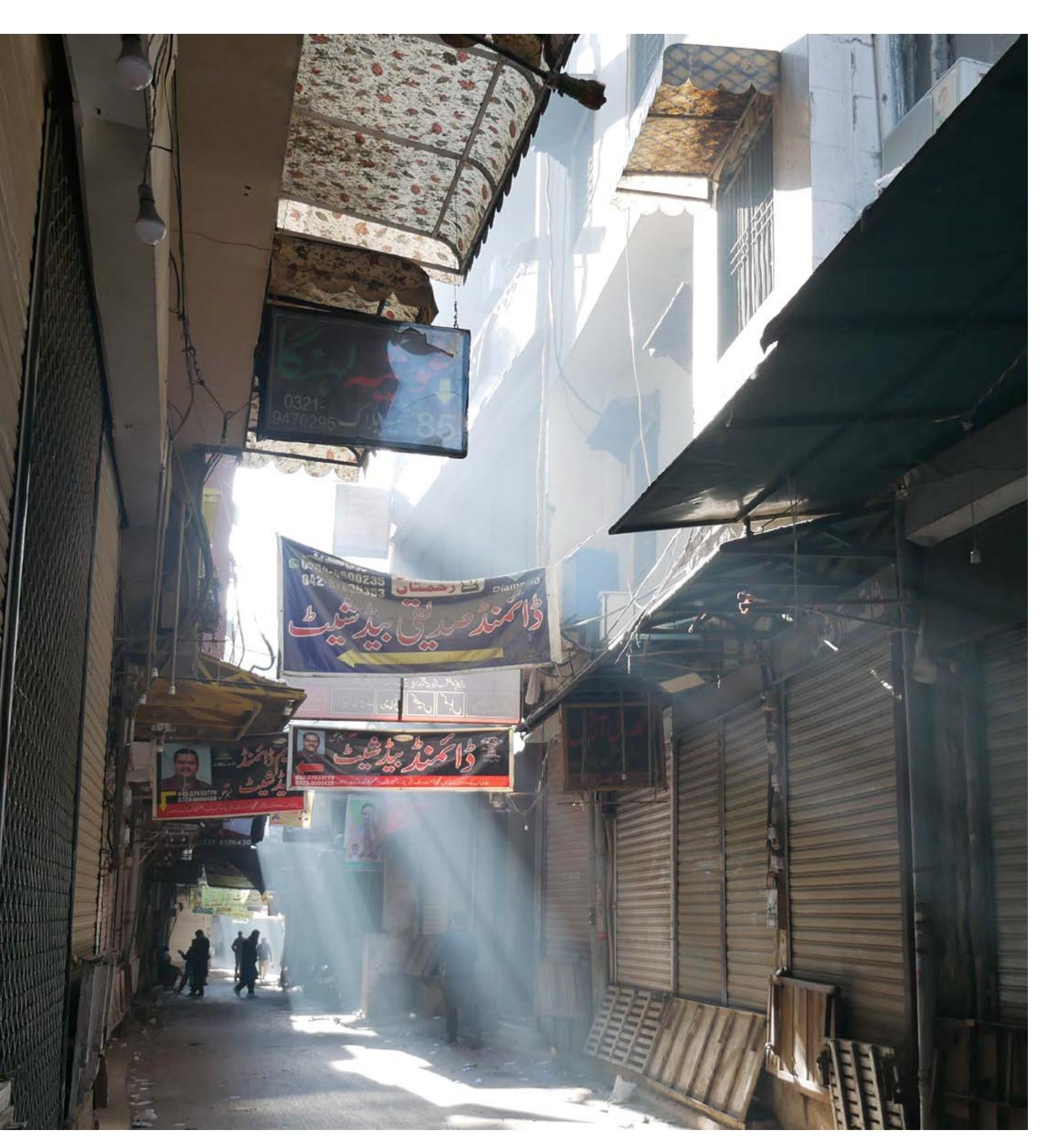
Sweepers clean a narrow alley in Lahore, kicking up dust that is visibly highlighted by shafts of sunlight. This resuspension of road dust is a major contributor to the city’s particulate matter load, turning routine maintenance into a secondary source of pollution. Photo by Pakistan Air Quality Initiative
Footnotes
-
Ahmed, K. et al. (2005) Environmental health and traditional fuel use in Guatemala. ↩