policy-history
The 20-Year Full Circle
Ahmad Rafay Alam ·
← Unveiling Pakistan's Air Pollution
From courts to commissions: For two decades, the fight for clean air has been led not by proactive policy, but by judicial activism, with courts repeatedly forcing the government to form commissions and create plans.
The implementation gap: Despite a host of sophisticated policies on paper, on-ground enforcement has been weak, inconsistent, and often focused on politically convenient targets rather than the largest polluters.
The politics of denial: A persistent lack of investment in a credible, nationwide air quality monitoring network has allowed for a culture of “plausible deniability”, enabling authorities to dispute independent data and avoid accountability for the true scale of the crisis.
To understand why Pakistan’s air remains toxic, we must look beyond the smokestacks and into the corridors of power. Ahmad Rafay Alam provides a critical, 20-year history of the country’s struggle with air pollution policy, revealing a vicious cycle of judicial activism, reactive policymaking, and failed implementation. This chapter is an essential accounting of how, despite commissions, court orders, and a proliferation of new rules, we are still where we started—choking on the consequences of inaction.
Air pollution in Pakistani cities, especially Lahore, is among the worst in the world. This did not just happen overnight. It has taken years of effort and after two decades, we appear to be right back where we started.
Let me explain how this has happened, by providing a historical overview of the various legal, judicial and policy-based attempts to regulate or improve air pollution in Pakistan. Since Lahore’s air pollution has been the most widely reported, for reasons that will be made clear consequently, the major part of this overview will cover the regulatory attempts made in Punjab, as this is where the policy battle has been most intensely fought.
The era of judicial activism
In 1997, a writ petition was filed in the Lahore High Court by then-lawyer Syed Mansoor Ali Shah in the public interest and on behalf of the citizens of Lahore complaining of the quality of air in Lahore.1 The petition contended that air pollution has a “severe effect on human life, specially on newborn and unborn infants” and asserted that “motor vehicle emissions account for approximately 90% of total annual emissions of hydrocarbons, aldehydes, carbon monoxide, carbon dioxide, sulfur dioxide and nitrogen oxide”.
In response, the Lahore High Court constituted a Commission chaired by Senior Advocate and the pioneer of Environmental Law in Pakistan, Dr. Parvez Hassan and tasked it “to submit a report on feasible and practical solutions and measures for monitoring, controlling and improving the vehicular air pollution in the city of Lahore”.2
The Commission executed its terms of reference, including the hosting of Pakistan’s first international air quality workshop in 2005, and filed its report before the Court. In this report, the Commission highlighted the need to have ambient air quality standards in line with WHO guidelines, improved air quality monitoring and planning, cleaner fuels for automobiles, standards for public buses and rickshaws, and vehicle emission standards.
The case was decided in 2006 with the Lahore High Court issuing directions to the Government of Punjab to introduce CNG for Euro-II fuel compliant rickshaws, phase out wagons for public transport and replace them with minivans, set ambient air and fuel quality standards, and prioritise the establishment of air quality monitoring stations, amongst other things.3
As a result of this case, four-stroke CNG rickshaws were introduced into the market and fuel quality standards were established for the first time.
The 18th Constitutional Amendment was passed in 2010 and took effect in 2012. As a result, a number of subjects of governance were devolved to the provinces, including environmental regulation. By 2014, all four provinces had passed their own environment laws, establishing their own environment protection agencies (EPAs) and conferring on them the powers to enforce quality standards etc.
Each of the provinces have since adopted their own quality standards for industrial gaseous emissions, ambient air as well as for automobile exhausts. By and large, these emissions standards are the same (with the exception of PM10 and PM2.5 levels for ambient air in Sindh and the method of measurement of PM in Punjab).1 Provincial environment protection laws also confer onto provincial EPAs the power to require automobiles to use particular fuels and air pollution devices to control vehicle pollution but, till the writing of this article, none of the EPAs have exercised this power.
The smog crisis of 2016 and the rise of citizen data
In November 2016, Lahore and its surrounding areas witnessed a dramatic smog event.
Smog—literally smoke and fog—is an air pollution phenomenon when air pollution remains trapped near the surface of the earth by an inversion cloud.
For a day or two, Lahoris, deceived by what they thought was the early onset of winter and their much-beloved dhund, found themselves with sore throats and patchy eyes. The inversion cloud dissipated, the smog dispersed, and public attention was soon drawn to other things. However, a public interest writ petition was filed, seeking directions from the Court to EPA Punjab to take notice of the deteriorating air quality situation in the city. The case was taken up by Justice Mansoor Ali Shah, who directed the Environment Protection Department (EPD) of the Government of Punjab to come up with a policy to combat the “smog”.5
By this time, the Pakistani Air Quality Initiative (PAQI) had been set up by Karachi-based Abid Omar, who had just returned to Pakistan after working several years in Beijing, China. Abid had been struck by the response the Chinese had to air pollution—they immediately took it as a challenge to be bested. And much of that response had to do with citizen awareness playing a crucial role.
Air quality data made available from monitoring devices set up at the US diplomatic missions in Beijing and Shanghai and published on the internet gave citizens real-time information about the quality of air they were inhaling. The Chinese administration was forced to respond to a massive public reaction. Similarly, PAQI’s monitoring network was noting the deteriorating air quality in Pakistani cities and realised that something had to be done.
PAQI started by installing low-cost air quality monitors in Karachi, Lahore, Islamabad and Peshawar, one in each city. A second monitor was added in Lahore by early 2017, and the data was made available through the website of the monitoring devices as well as on social media. Concerned citizens of these cities could now have a sense—albeit a very unrefined one—of the poison they were inhaling into their lungs.
Understanding the year-round haze
As the summer of 2017 began to give way to winter, the changing weather brought with it something all Pakistanis living in and around cities are now familiar with: poor air quality.
There are a number of reasons why air quality in Pakistani cities further deteriorates in the winter. This is not to say that air pollution is absent at other times of the year. Not at all. Poor air quality is a year-round public health emergency, only made worse in the winter. As temperatures drop, there is less tendency for the pollution generated to dissipate with rising hot air. With cooler temperatures, pollution tends to remain close to the surface of the
earth. While pollution levels are lower in the summer, they are still way above safe limits. It isn’t that there are less emissions in the summer. On the contrary, the same number of vehicular, industrial and other emissions are being produced the whole year round, more or less.
Another factor is geography. The South Asian subcontinent was formed millions of years ago through continental drift; with the part of India south of the Deccan Plateau colliding with the continent of what is now Asia. This collision resulted in the creation of a gigantic wall: the Hindu Kush, Karakoram and Himalayan mountain ranges. Over the millennia, water deposited on these ranges by the summer monsoon froze and became ice, and in turn, that ice melted into the streams and lakes forming the Indus and Ganges basins. The Indo-Gangetic Plains are like a trough between the HKH Ranges and the Deccan Plateau.
This historical trajectory reveals that Pakistan has built a substantial legislative framework for environmental protection over decades, yet the practical implementation of these laws has remained a persistent challenge.
And air pollution, especially in winter, tends to get stuck in this trough. Any satellite image of air pollution of South Asia reveals the startling truth: air pollution is a regional problem stretching from Kabul to Dhaka.
The smog commissions: policy by court order
As directed by the Lahore High Court, the Environment Protection Department of the Government of Punjab formulated a “Policy and Action Plan for Control, Mitigation, Advisory and Protective Measures in Extreme Weather Conditions of Dense Smog in the Punjab” in September 2017. This Policy recommended the introduction of lowsulfur fuels and adoption of Euro-II fuel quality standards for vehicles, the use of pollution control devices such as catalytic converters in automobiles, better traffic management, controlling the burning of municipal and crop residue, the establishment of a network of air pollution monitors, controlling dust from construction and road shoulders, planned urban development and regional cooperation in reducing environmental pollution.6
This Policy also adopted an air pollution index which linked specific action at particular air pollution levels. This index resembled the US EPA’s Air Quality Index but set the
categories for harmful levels of air pollution much higher than the US EPA. Also, this air pollution index remains at odds with the National Environmental Quality Standards for Ambient Air, which require the assessment of nine different air pollutants.
This ‘Smog Policy’ was placed before the Lahore High Court during its November 2017 hearing of the Walid Iqbal case and incidentally, at the time of another smog event. Justice
Mansoor Ali Shah had become the Chief Justice of the Lahore High Court by then. He was not impressed with the Policy and in December 2017, he ordered the formation of a Commission, to be chaired, again, by Dr. Parvez Hassan to “combat smog and to formulate a Smog Policy for Punjab, which identifies the root causes and prescribes a plan to protect and safeguard the life and health of the people of Punjab”.
By this time, the media coverage of the Walid Iqbal proceedings as well as air quality data made publicly available by PAQI led to the news that Lahore’s air pollution was some of the
The citizens of Pakistani cities deserve more than token policymaking for the sake of policymaking… the ones that have successfully addressed the issue all have one thing in common: a shared vision of a clean air future that is longer and more sustainable than the five-year election cycle.
worst in the world. Articles appeared in the international media such as New York Times, Associated Press, The Guardian as well as local newspapers. PAQI’s mission to raise awareness about air quality was beginning to work.
Chief Justice of Lahore High Court Mansoor Ali Shah was elevated to the Supreme Court of Pakistan in early 2018. However, then-Chief Justice of Pakistan Saqib Nisar had taken suo motu notice of the deteriorating air quality in the country in March 2018 and directed the Commission formed by Justice Shah to submit its report to the Supreme Court instead of the Lahore High Court. Following these orders, the Commission filed its report before the Supreme Court in May 2018.
This Smog Commission’s report set out 17 voluntary and mandatory recommendations. The voluntary actions were that rice growers, brick kiln and steel re-rolling mill owners agreed to not burn rice stubble, shift to zig-zag brick kiln technology and shift to cleaner production methods respectively.
The mandatory actions recommended by the Smog Commission were comprehensive and multifaceted. They called for the strict implementation of the ban on burning municipal waste and urban biomass, alongside the adoption and full implementation of the Punjab Clean Air Action Plan previously formulated under the “Smog Policy” of 2017. A significant directive was for the Health and Environment Protection Departments to employ the Public Health (Emergency Provisions) Ordinance, 1944, enabling them to mobilise various government departments by making rules, prohibiting harmful
activities, relocating medical personnel, and allocating resources to tackle high levels of air pollution on an emergency basis. Further actions included the gathering of data from public and private hospitals and clinics regarding patients suffering from air pollution, and the requirement for Health and Environment Protection Departments to adopt standard operating procedures for smog response as well as set up dedicated smog response desks. A key recommendation urged the immediate adoption, dissemination, and subsequent implementation by the Government of the Punjab of Standing Instructions for Management of Episodes of Poor Air Quality, with the Commission specifically advising health alerts for preventive action when the AQI crossed the 300 threshold. Finally, the mandatory actions encompassed a targeted afforestation campaign, the placement and regular updating of air quality data on the Environment Protection Department website, and the pursuit of a transboundary agreement for controlling air pollution.
The Supreme Court of Pakistan appreciated the work of the Smog Commission and directed the contents of the report be read as part of its own order, thereby making the recommendations of the Smog Commission binding and enforceable.
Plausible deniability: the monitoring gap
General elections took place in Pakistan in August 2018 and a PTI government assumed charge of the Federal and Punjab governments. The considerable policy work that had been undertaken as a result of judicial activism came to the aid of the new Government of Punjab, which focused primarily on tree plantation drives (as part of its 10 Billion Tree Tsunami Project), crackdown on crop burning and compelling brick kiln owners to adopt zig-zag brick kiln technology.
At the same time, PAQI’s network of low-cost air quality monitors was expanding. Over a dozen monitors had been installed in Lahore, Islamabad and Karachi. However, all provincial EPAs, without exception, disputed the accuracy of these monitors and denied the record air pollution levels they were displaying.
This position stems from the method of measurement prescribed in the ambient air quality standards adopted by the provinces. The low-cost air monitors installed by PAQI use lasers to measure PM2.5 levels. The ambient air quality standards require Beta Ray Absorption as the means to measure PM2.5. The problem here is that the machinery required to measure the nine pollutants scanned for in the ambient air quality standards is very expensive. On the other hand, the public has a right to know the quality of air it is exposed to.
Having a network of reference-standard air quality monitors that comply with the quality standards is prohibitively expensive whereas low-cost monitors can be set up throughout cities and provinces for a fraction of the cost.
There must be a way for a low- and middle-income country (LMIC) like Pakistan to use reference-standard air quality monitors along with a network of low-cost monitors to provide reliable real-time air quality data. Without a network of air quality monitors, it is impossible to measure air quality, and equally impossible to do anything about it.
This “plausible deniability” of the data collected by PAQI’s low-cost monitoring network has allowed the EPA Punjab to rely instead on the two or three working reference-standard air quality devices in its possession. While these machines may be accurate and their data uploaded onto the website of the Environment Protection Department fairly regularly, they cannot and do not present an accurate picture of the air quality of Lahore, let alone the province of Punjab. It has also not stopped the local and international media from using the PAQI data to constantly report the poor air quality in Pakistani cities.
The paradox of policy: declaring a calamity
The winter of 2019 also saw elevated levels of air pollution. A particularly bad spell of air pollution in November prompted the Government of Punjab to close all schools in the Lahore, Gujranwala and Faisalabad districts for a day.
The lockdowns in 2020 due to the COVID-19 pandemic saw reduced levels of air pollution arising from restricted automobile use and minimal industrial activity. I recall the clear
Ahmad Rafay Alam highlights the persistent disconnect between policy intent and on-ground reality, the challenges of institutional memory, and the “vicious cycle” of decisionmaking, ultimately questioning the efficacy of past approaches and setting the stage for a re-evaluation of governance strategies.
skies during the lockdown period. It became clear to me that we knew not only what needed to be done to improve air quality but that tangible results were only a few days of effort away.
The onset of winter in 2021 saw the Government of Punjab take the unusual step of declaring smog a “calamity”, “especially in the territorial limits of the city of Lahore”. Under the Punjab National Calamities (Prevention and Relief) Act of 1958, whenever any part of the Punjab is affected by floods, famines, locust of pests, fire, epidemics or other calamities, the Government of Punjab has the power to declare the whole or any part of the province as a calamityaffected area and to appoint a Relief Commissioner to maintain order, check or control the calamity or reduce its extent and severity. In doing so, the Relief Commissioner has vast powers, including the power to direct any person to abstain from a certain act or to take certain measures with regard to certain property in his possession or under his management.
In declaring smog a calamity, the Government of Punjab appointed the Punjab Disaster Management Authority under the Board of Revenue as Relief Commissioner. A series of orders prohibited, within Lahore, the burning of crops, smoke-emitting vehicles, any industry working without an emission control system, stone crushers operating without wet scrubbers, the burning of solid wastes, rubbers and plastics, the use of sub-standard fuel and “any unauthorised activities which may cause pollution”.
In addition, the Relief Commissioner directed businesses within the territorial limits of Lahore to ensure that 50% of their employees work from home, and that public and private educational institutions increase the use of buses and vans by 50%. These orders remained in force for the
winter of 2021-2022, which reflected the Government of Punjab treating air pollution as a seasonal issue, and not a year-round public health emergency.
Similar calamity orders were issued by the Relief Commissioner during the onset of winter
in 2022 and 2023. While wide-ranging, the directions of the Relief Commissioner are not enforced across the board. Enforcement usually takes the shape of filing of criminal cases against farmers for crop burning and the sealing of brick-kilns that have not been converted to zig-zag technology. There has been no appreciable increase, for example, in the number of buses used by educational institutions.
Perhaps the reasoning for employing the Calamities Act rather than implementing court orders lies in the EPA field formation. The Punjab EPA focuses mainly on industrial pollution which is mostly concentrated in the urban areas of Punjab. It does not have the field formation to enforce zig-zag brick kiln formations, which are mostly in the rural areas. The PDMA and Board of Revenue, on the other hand, has a network of revenue officers throughout every district of the province and are perhaps better placed to carry out such conversions and enforcement. What they did not have in 2021, however, were air quality monitoring devices.
A flurry of policies, a failure to implement
In December 2022, the Punjab Environment Protection Council adopted the Health Advisory System for Critical Air Pollution Events (HAS-CAPEs). A Critical Air Pollution Event (CAPE) is a period of air pollution exceeding moderate AQI (more than 150) for at least five days. If a CAPE takes place, the HAS-CAPEs seeks to provide a mechanism for the issuance of health advisories so that remedial action may be taken by relevant government agencies.
The HAS-CAPEs envisages a Steering Committee chaired by the Chief Secretary of Punjab that will oversee the monitoring and management of health advisories as well as provincial and district CAPEs committees that will declare/undeclare CAPEs and ascertain what information needs to be disseminated. The schedule to the HAS-CAPEs provides a comprehensive list of measures that need to be taken and by which government agency, at differing levels of air pollution.
In April 2023, the Punjab Environment Protection Council approved the Punjab Clean Air Policy (with a phased action plan). This Policy seeks to improve air quality through emissions reductions and sustainable green development. It aims, for example, to reduce PM2.5 concentration by 30% by 2030 in Lahore, Faisalabad, Gujranwala and Multan; to reduce major air pollutants by 25% by 2030; to reduce greenhouse gasses by 30% by 2030; to install and operate 30 air quality monitoring stations by 2024; convert 100% of brick kilns to zig-zag technology by 2030; and increase urban forest cover by 10% by 2030 (all compared to 2022 levels).
In order to do so, the Policy sets out a number of interventions in the transport, municipal, industrial, agriculture, energy, housing and infrastructure sectors. The implementation of the Policy rests on the enforcement of the HAS-CAPEs and the Action Plan set out in the schedule to Policy. The Action Plan lists in detail the short, medium and long-term initiatives to be carried out in the various identified sectors. The Policy also adopts an AQI classification system that is closer in line to the US EPA classifications, compared to the classifications adopted in the 2017 Smog Policy.
Interestingly, just a month later, in May 2023, the Federal Government adopted the National
Clean Air Policy (NCAP). This was unusual as the responsibility of governing environment issues such as air quality fell solely to the provinces after the 18th Amendment.
Nevertheless, the NCAP aims to reduce emissions in the five priority sectors of transport, industry, agriculture, waste and household/residential by 21% by 2030 and by 70% by 2040 (compared to 2020 levels).
And, as if to complete a loop that started nearly 20 years ago with the Syed Mansoor Ali Shah case filed in the Lahore High Court, NCAP seeks to improve fuel quality in transport by shifting to Euro-V by 2025 and Euro-VI by 2030. In the transport sector, the NCAP seeks to improve the capacity of motor vehicle testing, the phasing out of obsolete technologies and the promotion of electric vehicles. However, despite the detailed interventions for each sector mentioned in this Policy, the fact remains that transport, agriculture and waste management are all subjects of provincial governance responsibility. The NCAP appears to make policy promises for the provinces to carry out and pay for.
In June 2023, the Environment Protection Department notified the Punjab Environmental Protection (Smog Prevention and Control) Rules. Although made after the Punjab Clean Air Policy, these Rules do not reference or mention it and instead seek to address smog by stipulating Standard Operating Procedures (SOPs) for brick kilns, industrial units, resource recovery units, tyre pyrolysis plants, stubble and waste burning and motor vehicles. These SOPs range from requiring the installation of pollution control devices (for industry) to a complete prohibition on activity (for tyre pyrolysis plants). Violations of the SOPs are met with penalties prescribed in the rules which range from fines (for motor vehicles, industrial units and burning crop stubble or waste) to demolition (in the case of brick kilns).
Twenty years later: a full circle of failure
In the two-decades of air policy formulation in Pakistan, some clear trends are apparent.
For the first decade, air pollution policy was spearheaded by judicial activism, starting from the Mansoor Ali Shah case and ending with the Smog Commission. In the last decade, air pollution policy has emerged from the government itself. Further, almost all the policy development has been focused on Punjab, and specifically Lahore, and ignores the fact that air pollution afflicts every major city of Pakistan. Lastly, air pollution is many times confused with smog and treated, as a result, as a seasonal phenomenon rather than the year-round issue that it is.
Analysing the implementation of the policies that have emerged since the beginning of this century, it is apparent that while these policies have from the beginning identified automobile fuels and the transport sector as the major contributor to year-round air pollution, considerable action has only been taken mostly against brick kilns and crop burning.
The impression that one can be forgiven for getting is that the implementation tends to focus on the poor and politically less influential. And after 20 years, there is still no effective air quality monitoring system relied on by the EPAs. The deteriorating air quality in Pakistani cities is as much caused by pollution as it is by poor and ineffective governance.
The detail and nuance of the policies evolved in Punjab should give rise to some optimism. The Punjab Clean Air Policy (and phased action plan), if acted upon, could improve air quality in Punjab dramatically. Despite the Government of Punjab adopting this policy, policymakers appear to not have read or want to comply with it. Despite the caretaker Government of Punjab adopting the Policy and Smog Rules, the enforcement actions it took in the winter of 2023 included washing some of the main roads in Lahore with water and attempting cloud seeding (neither of which are mentioned in the Punjab Policy).
The citizens of Pakistani cities deserve more than token policymaking for the sake of policymaking. Other cities around the world have also faced air pollution issues and the ones that have successfully addressed the issue all have one thing in common: a shared vision of a clean air future that is longer and more sustainable than the five-year election cycle.
Ahmad Rafay Alam is an environmental lawyer specialising in the energy, water, natural resources, and urban infrastructure sectors.
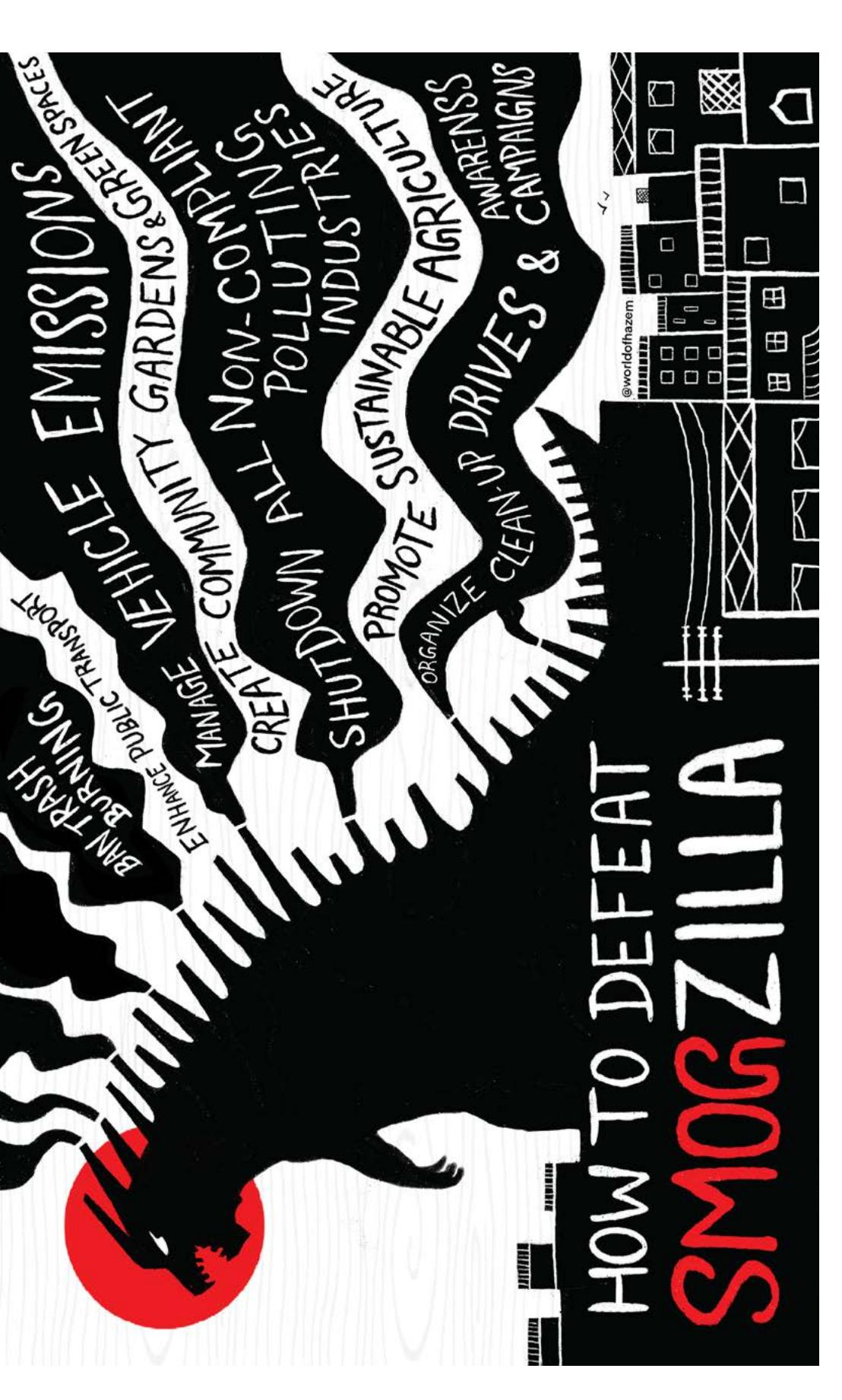
Hazem Asif’s satirical poster, Smogzilla Attacks Punjab, reimagines the pollution crisis as a giant, destructive monster besieging the city. The piece uses the visual language of vintage cinema to critique the scale of the threat and the urgency required to defeat this modern-day monster.
Footnotes
-
The Sindh Environment Quality Standards for Ambient Air set the 24-hour average for PM2.5 at 75 micrograms per cubic metre whereas they are otherwise 15 micrograms per cubic metre in the other provinces and Islamabad Capital Territory. In Punjab, the method of measurement of PM2.5 is “preferably” Beta Ray Absorption Method whereas in the other provinces it is only Beta Ray Absorption Method, giving the EPA Punjab some flexibility in the type of equipment that may be used to measure PM2.5. ↩