clean-cooking
Clean Cooking
Khizr Imran Tajammul ·
← Unveiling Pakistan's Air Pollution
Exploring the barriers and challenges of clean cooking adoption
A 10-million household crisis: An estimated 10 million households in Pakistan still rely on polluting open fires or inefficient traditional stoves for their daily cooking needs.
Beyond technology: Adoption of cleaner stoves is not hindered by a lack of technology, but by a complex web of barriers including low purchasing power, mismatched culinary needs, and gender dynamics where men often control finances but are not the primary users.
Government support is essential: A sustainable market for clean cooking solutions cannot be built on market forces alone. It requires a robust national strategy with government support for local manufacturing, consumer awareness, and innovative financing.
The smoke that fills the lungs of millions of Pakistani women and children is a daily crisis born from a simple act: cooking a meal. Khizr Imran Tajammul moves beyond the lab and into the village, drawing on years of field experience to explain why so many wellintentioned clean cooking solutions have failed. This chapter is a clear insight into the stubborn realities of poverty, culture, and gender that technology alone cannot solve and delivers a roadmap for effective solutions.
The off-grid world, an estimated three billion people globally, relies on combusting solid biomass—such as firewood, crop residue, and animal manure—to cook food and heat their homes.1 This practice extends to agriculture, where agrarian communities often burn stubble to clear fields, contributing further to air pollution. Pakistan mirrors these trends; in the agricultural heartland of Punjab alone, up to 8.5 million tonnes of stubble are burned annually.2
Furthermore, a significant portion of Pakistan’s population lacks access to modern energy infrastructure. An estimated 56 million people live without electricity, and approximately 78% of the nation’s 240 million people lack access to the natural gas network. Consequently, households utilise varying proportions of traditional biomass and, where affordable, Liquefied Petroleum Gas (LPG) for their cooking and heating needs.
Based on these energy access limitations, an estimated 10 million households in Pakistan still use some form of open fire or inefficient traditional stoves (often called ‘three stone stoves’ or ‘mud stoves’) for daily cooking. These methods combust fuel inefficiently, releasing harmful emissions and wasting energy. Undoubtedly, these households stand to gain significantly from adopting clean cooking solutions—defined here as fuel-efficient alternatives that reduce emissions, prevent respiratory illnesses linked to indoor air pollution, and conserve fuel resources.
Despite these clear benefits, numerous public and private sector efforts to introduce and scale up clean cooking solutions in off-grid Pakistan, dating back to the 1960s, have largely failed to achieve widespread adoption. This chapter delves into the complex barriers hindering this transition, drawing heavily on the experiential lessons learned by Jaan Pak, a clean cooking company that has been developing solutions for Pakistan’s off-grid communities since 2014.
The national context: a difficult starting point
Before examining household-level barriers, it’s crucial to acknowledge how broader macro level issues in Pakistan impact the clean cooking landscape, particularly concerning public health priorities and national energy infrastructure.
Health priorities and environmental management
Respiratory illnesses, largely stemming from poor air quality (both indoor and ambient), represent a major health burden—yet they often do not receive commensurate priority within the public health agenda, despite claiming more lives annually in Pakistan than malaria and HIV combined. The national response to air pollution often appears inadequate. Access to reliable public information on air quality can be limited or subject to manipulation, potentially hindering public awareness and governmental accountability for environmental management. Furthermore, enforcement of environmental regulations, including bans, taxes or fines on environmental offenders can be inconsistent, and are governed through antiquated, ill-defined policies that persecute the poor and pardon those in power. In the recent past, often at the peak of the smog season, we see smallscale farmers behind bars for burning stubble while coal power plants and industrial polluters puff up tonnes of greenhouse gases into the atmosphere every day. Within this context, developing and implementing a comprehensive national clean cooking strategy often remains an aspirational goal within broader social development policy frameworks rather than a high-priority, well-resourced national programme.
Energy policy constraints
Pakistan’s national energy policy, particularly regarding the pricing and accessibility of natural gas and LPG, presents another significant macro-level constraint. Given the historically subsidised price of natural gas for connected households, widespread natural gas access would make alternatives like LPG and other clean cooking solutions uncompetitive. Therefore, Pakistan’s policies governing the supply, distribution, and pricing of these primary fuels are intimately connected to the feasibility and potential scale of any national clean cooking strategy.
Why good stoves fail: understanding the user
Beyond the variables highlighted above, clean cooking solution providers will need to consider the following barriers to customer adoption in Pakistan.
Economic realities
Off-grid households typically have limited purchasing power, representing a fundamental barrier to adopting new technologies. In simple terms, putting food on the table is more important than cooking efficiently without fumes. While clean cooking enterprises can emphasise that fuel-efficient stoves save money over time, this argument resonates most strongly in communities that primarily purchase fuel rather than gathering it at no direct monetary cost. For instance, agrarian communities in Punjab often utilise readily available dung cakes and crop residue, making them less immediately motivated by fuel savings compared to communities in northern regions like Gilgit Baltistan, where biomass scarcity necessitates purchasing expensive fuel.
Jaan Pak found week-long cookstove trials effective in demonstrating fuel savings to fuel-purchasing communities, leading to customer conversions. However, such trials are resource-intensive.
Microfinance institutions offer a potential avenue to bridge the affordability gap, though experience suggests microfinance may be more readily adopted for enabling entrepreneurship through investments in small business ideas, like sourcing cattle or funding inventory for a new retail store, rather than for cost-saving devices like cookstoves. A clean cookstove leads to fuel savings, but for low-income households to protect those savings for micro-loan payments may be more challenging than setting aside revenue from a new business.
Regional differences in existing practices also influence willingness to pay. Communities in Balochistan, Khyber Pakhtunkhwa , Gilgit Baltistan, and Azad Jammu & Kashmir are already accustomed to purchasing metal sheet cookstoves and tin chimneys to remove harmful solid fuel fumes from their homes. These communities are generally more willing to pay for a fuel-efficient, clean cooking technology similar to what they already use. The behaviour challenge here is “spending more money towards a longer lasting, more fuel efficient product”.
Conversely, in Punjab and Sindh, many off-grid households use mud or cement stoves made by hand at home, with virtually no money. The very idea of “buying” a cookstove can seem absurd to many, although adoption can still occur. Jaan Pak, for example, achieved some success in Punjab where a small percentage of adopters across larger, densely packed communities has led to more customers than a larger percentage across smaller, less dense communities.
Lastly, the “power” in purchasing power largely resides with men, who may not be the primary users of the cookstove and thus less motivated by its benefits. The off-grid marketplace – both suppliers and consumers – are mostly men. Gaining the interest of men, unlikely users of a clean cooking product, can be challenging.
Gaining men’s interest requires specific strategies. For example, the company Biolite integrated a thermoelectric generator into their cookstove, allowing users to charge mobile phones while cooking, successfully capturing male interest in India—an approach worth exploring in Pakistan. However, technology isn’t the only solution in a male-dominated marketplace; leveraging women’s existing informal economic networks is crucial. Jaan Pak successfully collaborated with the Rural Support Programme Network to train and onboard over 50 women entrepreneurs as retailers. Engaging other influential women, such as community midwives, could further enhance adoption, necessitating field teams composed primarily of women.
It is incumbent upon Pakistan’s governmental bodies to develop the prerequisite policies, infrastructure, financing mechanisms, and supportive legislation needed to establish and sustain a thriving clean cooking industry.
Culinary preferences and technology fit
Replacing an open fire with a clean cooking solution sounds straightforward in theory, especially when it provides substantial health, environmental and economic benefits. However, a closer look reveals how complex implementation really is.
Local culinary practices are deeply ingrained and highly variable. How communities cook their meals and what they cook matters. Since culinary behaviours vary globally and food preparation is unique to each community, the first step in developing a clean cooking solution is understanding the specific culinary behaviour of the target community. In Pakistan, where roti and rice are often accompanied with lentil, vegetable and meat curries, the diversity in utensils, recipes and varying sizes of roti play a major role in determining suitable clean cooking technologies.
Jaan Pak learned this lesson when initially importing and piloting internationally best-selling biomass cookstoves from companies like Envirofit, Biolite, and Burn Manufacturing. These imported models often proved unsuitable for several reasons: their combustion chambers were too small or poorly designed for local fuels like large dung cakes or irregular wood pieces, requiring more work to break fuel down before combustion; their stove
top openings were often too narrow for making roti on traditional dome-shaped utensils (an inverted tawa); they struggled to accommodate the large cauldrons used for cooking meals for extended families, leading to instability or uneven heating; and finally, import costs (freight, customs, taxes) made them prohibitively expensive, significantly inflating the final price.
These challenges compelled Jaan Pak to develop a locally designed, “Made in Pakistan” clean cooking solution tailored to local needs. After 51 prototype iterations, the “Supreme Stove” was launched in 2017 as a single burner stove top for families of 7-10 individuals in Punjab. Four additional versions were to cater to diverse culinary preferences encountered across the rest of the country.
Unexpected pain points
Beyond broad economic and culinary factors, specific adoption drivers and deterrents can vary significantly between provinces, districts, and even contiguous communities. Field experience often uncovers poorly documented, unexpected issues. In Punjab, for instance, Jaan Pak found that many potential customers don’t fully understand or believe
An estimated 10 million households in Pakistan still use some form of open fire or inefficient traditional stoves. These methods combust fuel inefficiently, releasing harmful emissions and wasting energy.
in the ill effects of solid fuel fumes. They don’t necessarily link respiratory illnesses to poor air quality, so health concerns aren’t major drivers of adoption. Environmental concerns rank even lower. Instead, Jaan Pak customers reported two smoke-related problems: eye irritation and clothes smelling of smoke as frequently cited concerns. Another adoption driver was the novelty of a product that better organised cooking fuel and didn’t blacken utensils as much as an open fire. Counterintuitively, some Punjab households even perceived that eliminating fumes was actually detrimental because smoke repelled flying insects that would otherwise enter cooking pots and spoil food – a surprising barrier with no immediate remedy.
In KPK, extreme price sensitivity meant many households preferred cheap, disposable cookstoves made from tin chimneys and recycled vegetable oil containers that cost only PKR 300, but which lasted only a few months. Conversely, when attempting to offer higher-quality stoves via microfinance, Jaan Pak encountered resistance from lenders who found the products “not expensive enough” to create sustainable financial models. One solution to bundle cookstoves with essential household items like solar electrification or energy-efficient cooking utensils
emerged as a potential solution to increase loan viability.
In AJK, households often desired stoves for both cooking and heating and with relatively higher purchasing power, showed strong demand for efficient biomass models. Gilgit Baltistan presented the easiest market access, with communities readily attending demonstrations and exhibiting higher awareness of respiratory health and environmental issues, likely linked to higher literacy rates and the significant cost of purchased fuel in the region.
These diverse experiences underscore the necessity of in-depth community investigation, as no two are exactly alike. Door-to-door surveys and analysis of existing-energy-use profiles can provide a head start towards achieving the right product-market fit.
The promise and peril of climate finance
Following the inception of the Global Alliance for Clean Cookstoves (now the Clean Cooking Alliance) in 2010, impact investment and development funding spurred the growth of numerous clean cooking startups globally. Initial excitement centred on market-based solutions driven by patient capital, fuel savings, health benefits and economies of scale. However, the influx of multiple products, particularly in sub-Saharan Africa, sometimes led to “stove stacking”, where households acquired multiple stoves but continued using traditional methods, often perceiving the new stoves as temporary offerings lacking ongoing support. This limited the actual impact, dampened investor confidence due to low revenue generation, and made the sector less attractive.
Concurrently, carbon markets emerged as a potential revenue stream, supporting cookstove companies through carbon offset projects. Initially nascent with low carbon prices, these markets offered limited financial contribution. Today, however, monitoring, reporting, and verification standards for cookstove carbon projects are more robust, allowing for more reliably verifiable emission reduction claims that can generate valuable carbon credits. To leverage this finance, companies must navigate complex requirements. This involves using appropriate technologies certified for high combustion efficiency (e.g., at least 35% improvement over open fires) and durability (e.g., five-year lifespan), and adhering to methodologies like the Gold Standard foundation’s “Simplified Methodology for Clean and Efficient Cookstoves” for designing, monitoring, reporting, and verification systems that ensure carbon revenue outweighs project costs.1 However, the barrier to entry remains high, demanding specialised knowledge and potentially expensive protocols. Furthermore, minimum efficiency thresholds (e.g., 25%) can exclude many existing or lower-cost stoves, requiring technology upgrades and certified testing. Some carbon offset developers may also focus on larger-scale projects, creating difficulties for smaller enterprises.
The missing ecosystem: why businesses struggle
Establishing any business is challenging; doing so in an emerging industry serving lowincome customers with limited purchasing power is far more challenging. In Pakistan, a clean cooking business often operates outside established industrial categories and faces low intrinsic demand, as solutions are often perceived as nice add-ons rather than necessities, particularly since they are often offered free or highly subsidised. This positions many clean cooking ventures as social enterprises heavily reliant on external support to address open fire cooking practices for millions of households.
No new clean cooking business can tackle Pakistan’s open fire problem alone. Substantial public sector support is indispensable. This requires coordinated action from government institutions responsible for off-grid energy, public health, agriculture, manufacturing (e.g., for metal sheet fabrication), information dissemination, and education. To cultivate a thriving clean cooking industry for 10 million households in Pakistan, the government could play a crucial role by establishing testing laboratories to certify locally produced models, encouraging manufacturers through business loans or incentives, and providing tax benefits or subsidies to ease market entry. Such support would generate indirect positive impacts on the environment, health (especially maternal and child), household income and savings, and potentially gender empowerment. The Climate and Clean Air Coalition (CCAC) has previously funded the development of a national clean cooking strategy for Pakistan; how the government acts upon such frameworks will significantly influence the future of clean cookstove businesses and consumers nationwide.
Strategies for a clean cooking transition
The arguments for promoting clean cookstoves are compelling. A single improved stove can prevent the emission of 1-2 tonnes of carbon equivalent annually, mitigate fatal respiratory illnesses linked to indoor air pollution, and generate significant savings on fuel costs, especially where biomass must be purchased. Reducing overall biomass demand could also alleviate pressure on Pakistan’s dwindling forest resources, which are reportedly disappearing at an alarming rate of 47,000 hectares per year. Critically, since women and children are the primary users and beneficiaries of cleaner cooking, fostering this market creates unique economic opportunities for women entrepreneurs to retail solutions directly within their communities.
Addressing the complex challenges and establishing a viable, scalable market requires clear government ownership and robust support for a national clean cooking strategy. Generating
Khizr Tajammul explores past initiatives, market dynamics, and behavioural factors, offering insights into the multi-pronged strategies needed to accelerate a just and sustainable clean cooking transition in Pakistan.
sustained consumer demand hinges significantly on policy interventions that actively discourage traditional open fires, effectively communicate the health and environmental hazards of indoor air pollution, and promote the benefits and availability of certified clean cooking products. While manufacturers and retailers would benefit immensely from government-sponsored awareness campaigns, their capacity to supply quality products must be established beforehand.
Without dedicated public sector support—including potential consumer subsidies, capacity building for local manufacturers, widespread education on the dangers of open fires, access to business financing, and reliable testing infrastructure—clean cooking businesses face an uphill battle surviving solely on market forces, especially when serving low-income populations.
While the global energy transition progresses to clean energy, potentially reducing the size of the off-grid population over time, the market for clean cooking solutions in Pakistan remains vast and critically important today. The significant environmental, economic, and public health benefits offered by transitioning away from traditional cooking methods cannot be ignored. Among the
numerous barriers to adoption, affordability and culinary compatibility emerge as major determinants of consumer behaviour. While businesses must undertake thorough, contextspecific research to understand their potential customers, it is incumbent upon Pakistan’s governmental bodies—at national and provincial levels—to develop the prerequisite policies, infrastructure, financing mechanisms, and supportive legislation needed to establish and sustain a thriving clean cooking industry capable of reaching millions.
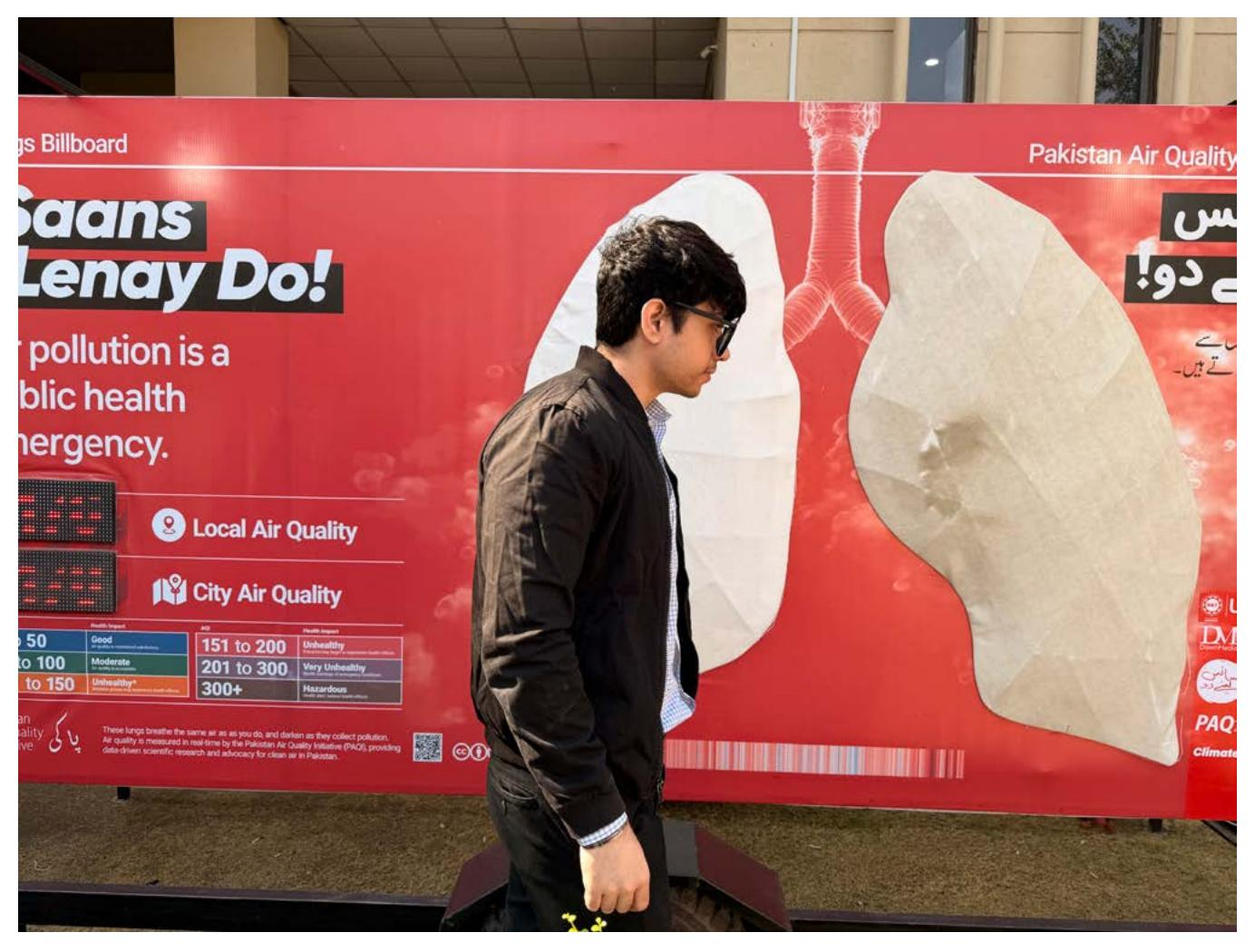
PAQI researcher Mahad Naveed walks past the ‘Saans Lenay Do!’ (Let Us Breathe!) billboard, a stark public health installation. Designed to mimic human respiration, the artificial lungs trap particulate matter from the ambient air, slowly turning from white to black to offer a visceral, undeniable proof of the toxic emergency unfolding in Lahore.
Khizr Imran Tajammul formerly led GHG accounting, inventory management and emissions mitigation for the Government of Northwest Territories in Canada. He is the cofounder of Jaan Pak and a Policy Analyst at Natural Resources Canada
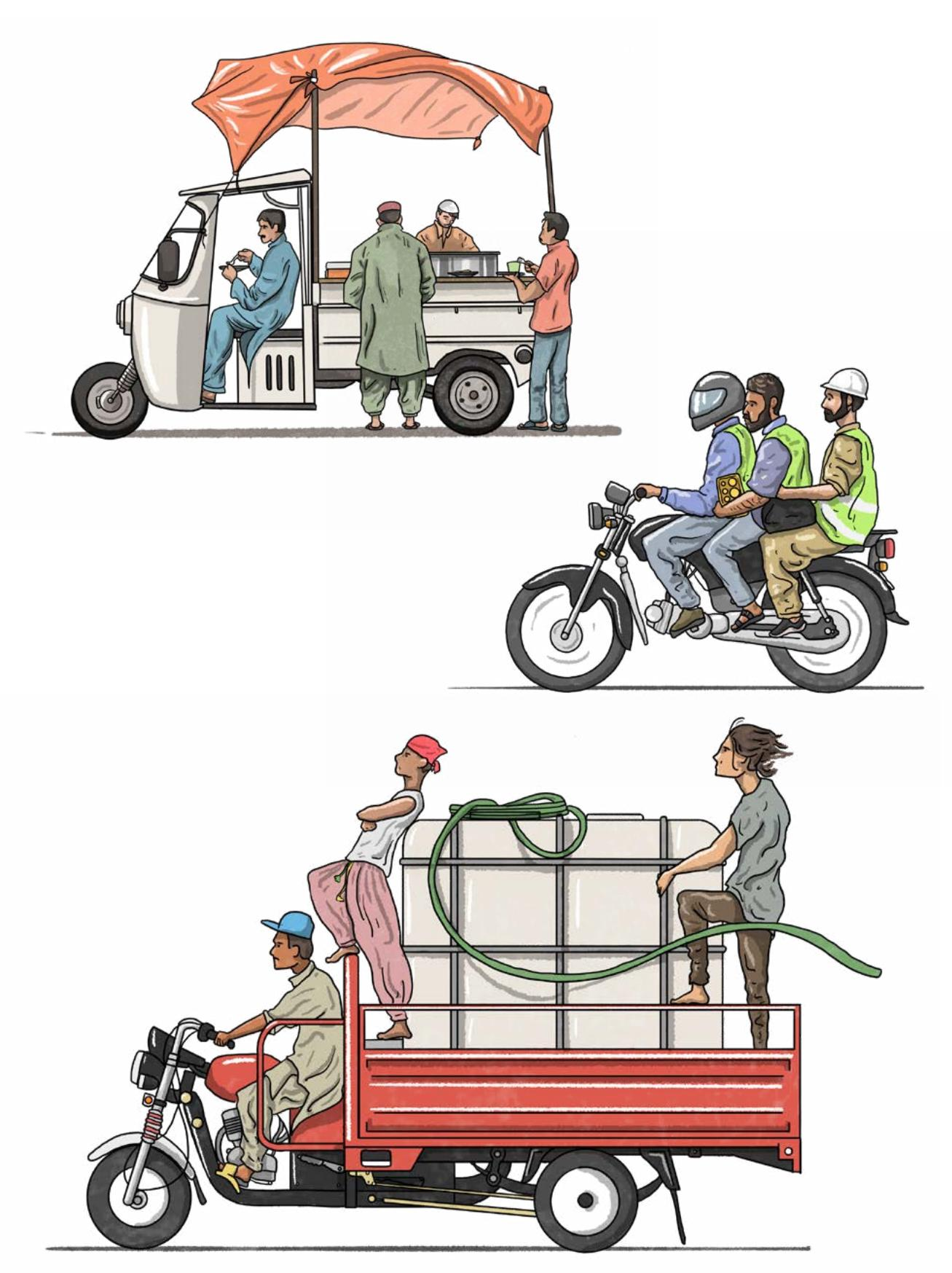
From the weaving rickshaw to the delivery loader, Maaz Jaan (@deconstruction_ station) illustrates the ‘people’s chariots’ that drive Pakistan’s economy. While these vehicles are essential for mobility, they are currently the primary source of streetlevel pollution, making their transition to electric power the single most critical step for urban public health.
Footnotes
-
‘The Gold Standard Simplified Methodology for Clean and Efficient Cookstoves’. Gold Standard for the Global Goals. ↩