public-health
The Right to Breathe
Senator Sherry Rehman ·
← Unveiling Pakistan's Air Pollution
by Senator Sherry Rehman
Clean air is not a privilege. It is a fundamental human right, and yet remains one of the most denied public good for citizens of Pakistan today. Without resorting to any hyperbole, the truth is that our reported and lived reality is bleak. Every breath we take seems to be laced with invisible poisons; triggering a slow form of environmental violence that shortens lives, cripples health, and weakens the very foundation of our economy and society. Given its pervasive scale and intensity, air pollution is now the country’s most unacknowledged serial killer, claiming more lives each year than conflict, terrorism, or natural disasters.
Air pollution is a public health emergency that respects no borders, class, or gender, while its burden falls heaviest on the vulnerable, the indigent, on women, and on children.
Clean air is not a luxury, says this report. I could not agree more. It is the most basic of rights. When a child cannot walk to school without inhaling toxic smog, the state has failed in its most elementary duty of protection, of providing a safe environment for its citizens. This report by the Pakistan Air Quality Initiative (PAQI) comes at a critical inflection point. For decades, policy inertia, weak regulation, and a lack of credible data have trapped us in cycles of denial and cosmetic fixes. Too often we have seen polluted air treated as a seasonal inconvenience rather than the systemic crisis that it is. Token band-aids such as road-washing, “smog cannons”, or sporadic bans have distracted us from addressing the true sources of toxic air: fossil fuels, unchecked industrial emissions, unregulated transport, burning crop residue, and weak climate governance. This report breaks through that smog of inaction with evidence, clarity, and an unflinching call to accountability.
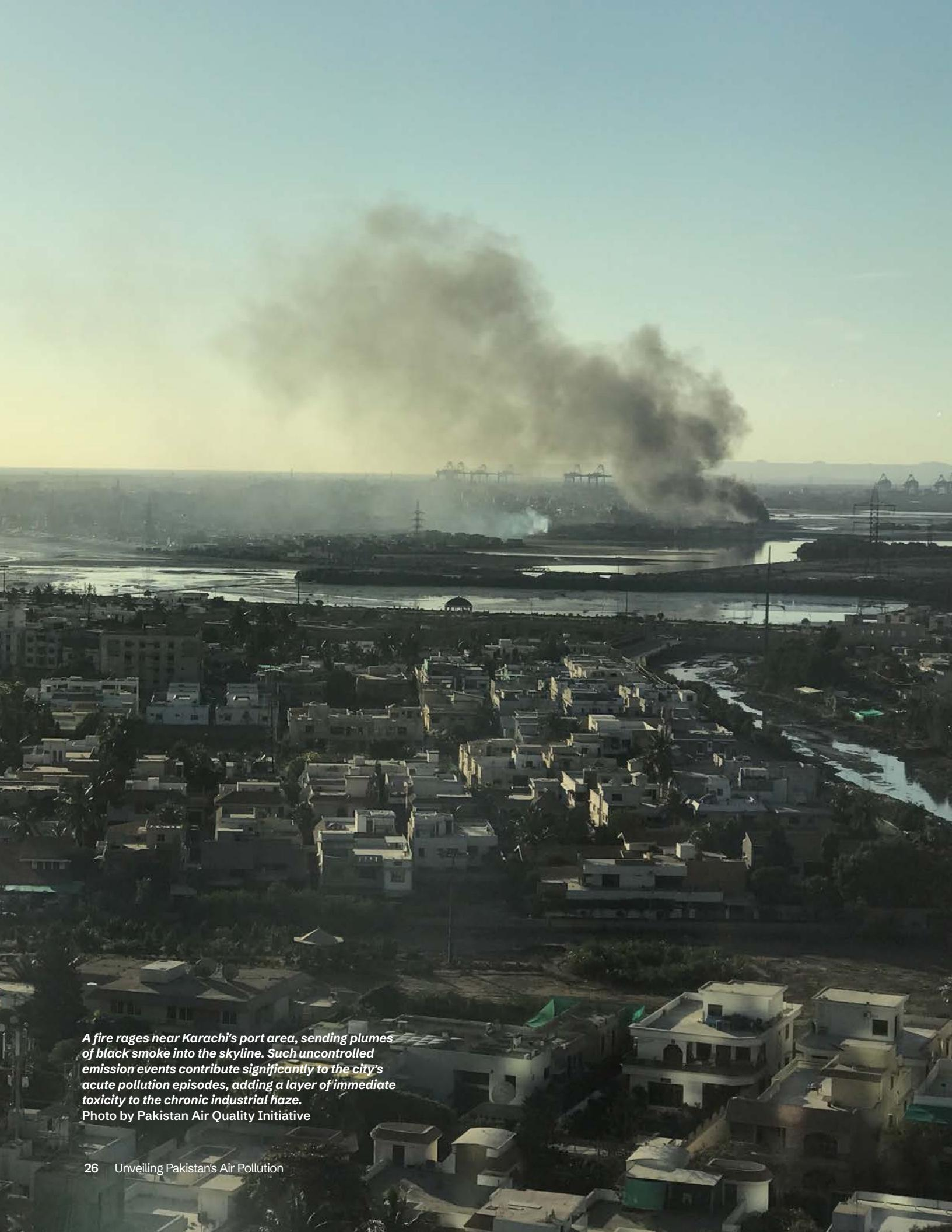
The findings are stark, and should serve as a wake-up call. Across our cities, each airshed bears its own unique emissions fingerprint. Highest in the rankings for poor air quality, Lahore – once celebrated as the city of gardens – now battles a three-front war of vehicular emissions, heavy industrial discharge, and a dense ring of toxic smoke-spitting brick kilns. Islamabad and Rawalpindi – minus the unfiltered, dirty industrial clusters encircling Lahore – are choked instead by transport and urban design failures. Although Karachi, despite its mega-city size is lower in the rankings, its air is often heavy with chronic industrial smog, port emissions and dust.
The science is unequivocal: air pollution in Pakistan is not a monolithic landscape, but a series of localised emergencies that demand tailored solutions, especially from fine particulate matter (PM2.5) – what this report calls the “invisible assassin” – and the chemical cocktail of other pollutants that laces our air with poison.
But air pollution should not just be seen as a public health emergency; it is also a social justice crisis. The loss of 3.3 years of life expectancy for the average Pakistani, and 5.8 years for the people of Lahore, represents more than a statistic; it amounts ultimately to many lives unjustly robbed of their futures. It amounts to the erosion of rights and opportunities, disproportionately borne by those least responsible and least able to protect themselves. Women, confined by a mix of gender inequity and circumstance to poorly ventilated kitchens, are routinely exposed to harmful cooking fuels that carry a double burden of household and ambient pollution. Children in such spaces, defined by multiple social deprivations including dirty air, grow up with stunted lungs and compromised cognitive development, their potential dimmed before they have a chance to flourish.
This is why addressing air pollution must be framed not just as a technical or environmental issue, but as a question of equity, governance, and survival. Air is a public good, part of the commons we all share in governing as well as breathing. Air pollution challenges in Pakistan – whether they be residue from crop burning in Punjab, or dirty air arising from industrial emissions – need not be seen as the inevitable cost of growth. It is a problem fuelled as much by inaction as ignorance. I have often warned in Parliament that we cannot fight 21st century crises with 20th century tools or governance. Clean air is inseparable from climate resilience, economic vitality, and national security. Every region, every action has a different mix of its own contaminants in the air. Pollutants like black carbon, for instance, not only make breathing laboured, they accelerate glacier melt, and directly endanger Pakistan’s water and food security.
The economic costs go hand in hand with the environmental ones. The overall toll of air pollution for Pakistan, estimated at over 6.5% of GDP annually, undermines our already fragile fiscal stability. Inaction is no longer affordable at many levels.
Yet, the path to clean air is not out of reach. The solutions are known, proven, and achievable if matched with political will. Transitioning to cleaner fuels, electrifying mass transit and two- and three-wheelers with implementation of EV policy across the board, the modernisation of brick kilns, and enforcement of real standards for industry need not feature in the public imagination as distant ideals, but immediate imperatives. Building a transparent, nationwide monitoring system, aligning our environmental standards with global health guidelines, and empowering the public with reliable data are steps that can and must be taken now. This is not tomorrow’s problem. This is a crisis cutting short lives today. Every day of delay carries a human cost we cannot afford.
For Pakistan, the question is no longer whether clean air is possible. The real question is whether we have the resolve to deliver it. Our citizens have waited too long, and they cannot wait any longer. Clean air must be recognised as a core part of our social contract, as central to dignity and survival as access to water, education, or healthcare.
What this report does, with rigour and precision, is provide the evidence base to finally move from rhetoric to reform. It is a foundational document for policymakers, regulators, civil society, and citizens alike. It maps the sources of our crisis, counts the human and economic costs, and offers a blueprint for action rooted in science, feasibility, and justice. Finally, it is a call to action that we cannot afford to ignore.
On a global pie chart, Pakistan contributes less than 1% of global emissions, yet we have turned into a ground zero for climate disasters, with rankings from 2022 showing up today in 2025 as the most climate-vulnerable country in the world. The injustice is real, but so is the ownership of responsibility and national-to-local action. There are many ways to protect our own citizens from the toxic air we breathe, and to restore the purity of its quality. This report is full of them.
I commend the Pakistan Air Quality Initiative for producing this vital national assessment. Let it not be another report that gathers dust on shelves. Let it be a turning point, the moment we chose to confront the crisis with courage, science, and responsibility.
Senator Sherry Rehman
Sherry Rehman is Chair of the Standing Committee of the Climate and Environment Committee of the Senate of Pakistan. She is also a former Federal Minister for Climate Change.