citizen-science
Citizen Action
Pallavi Pant ·
← Unveiling Pakistan's Air Pollution
Beyond the “smog season”: Public and media attention often peaks during the visible winter smog, creating a cycle of crisis and amnesia. Year-round data is crucial for addressing the chronic, invisible sources of pollution that cause harm throughout the year.
From data to dialogue: The rise of accessible air quality data from lowcost sensors and citizen-led initiatives like PAQI has been the single most important factor in breaking the silence around air pollution in South Asia.
A global model for change: Grassroots movements from Kyrgyzstan to Poland to Pakistan prove that when communities are equipped with reliable information, they can successfully drive policy change and hold authorities accountable.
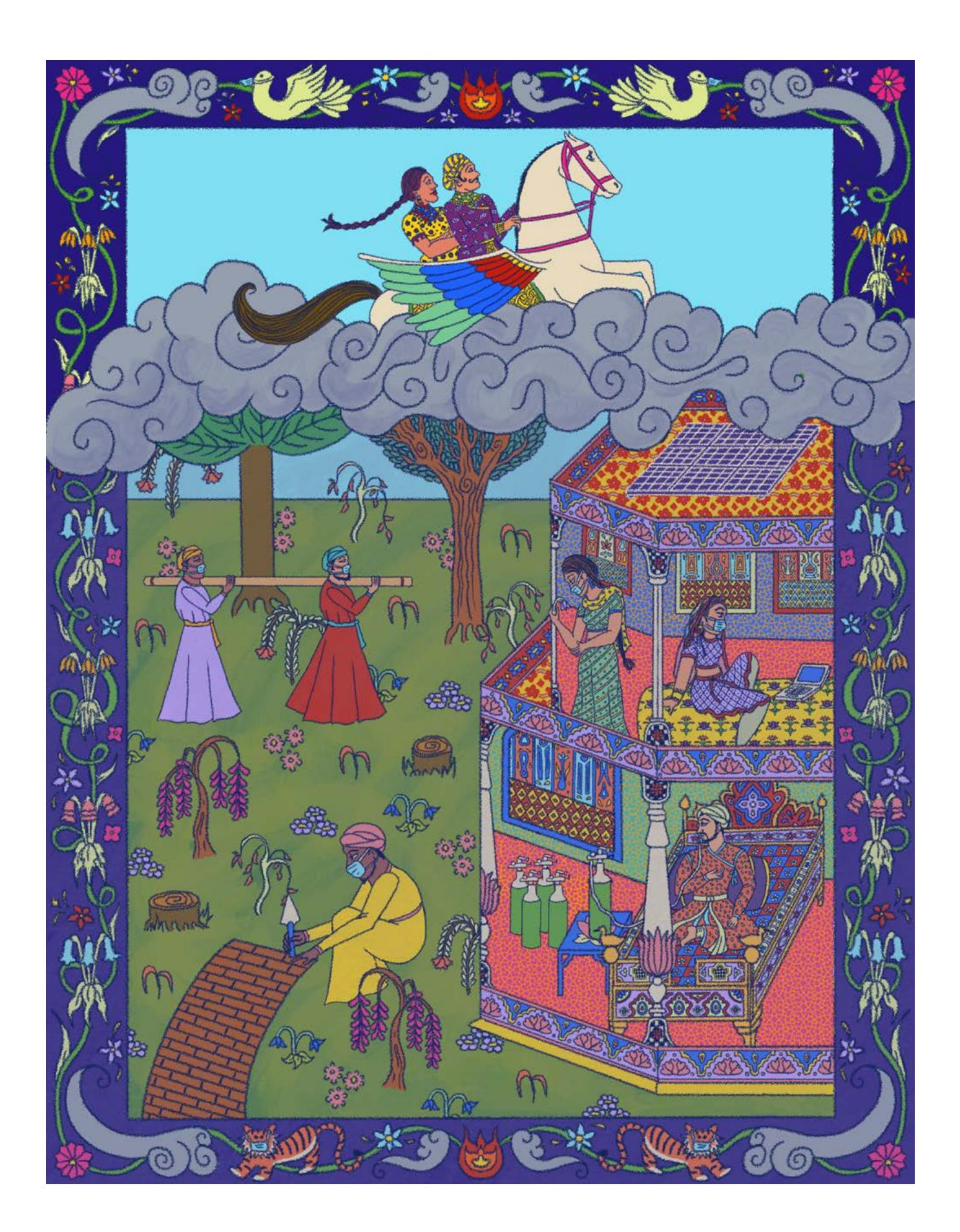
Shehzil Malik’s vibrant illustration depicts a woman wearing a mask, merging cultural aesthetics with the dystopia of modern environmental survival. The work underscores the gendered burden of pollution, highlighting how women must navigate public spaces that have become increasingly hostile to health.
Silence is the greatest ally of a crisis. For decades, air pollution has persisted in Pakistan, unmeasured and unmentioned. Dr. Pallavi Pant chronicles the rise of a new force in the fight for clean air: the citizen scientist. She explores how accessible, real-time data has shattered the silence, empowered communities, and turned passive victims into active agents of change. This chapter is the story of how a simple number; the AQI, can become the most powerful tool for reclaiming our right to breathe.
I knew something was changing when my parents started sending me WhatsApp messages about air quality and snapshots from the balcony showing polluted skies and poor visibility. Or when a friend—who usually didn’t think twice about such things—casually called me to ask which air purifier they should buy and how effective that might be for their kid with asthma. For many, air quality alerts and face masks have now become as routine as morning chai.
But for people working daily-wage jobs, air pollution isn’t just a new concern making headlines, it is a constant part of their reality. A taxi driver I spoke with years ago comes to mind. He had recently moved to Delhi, chasing economic opportunity in the nation’s capital. “Within weeks,” he told me, “I started coughing all the time, and my eyes would burn, and I had the sensation that I could not breathe.” He knew the air was to blame, but his options were limited. He was supporting a family back in his village, where the skies were blue and the air was still clean. For him, breathing in pollutants was an unwelcome but unavoidable side effect of earning a living.
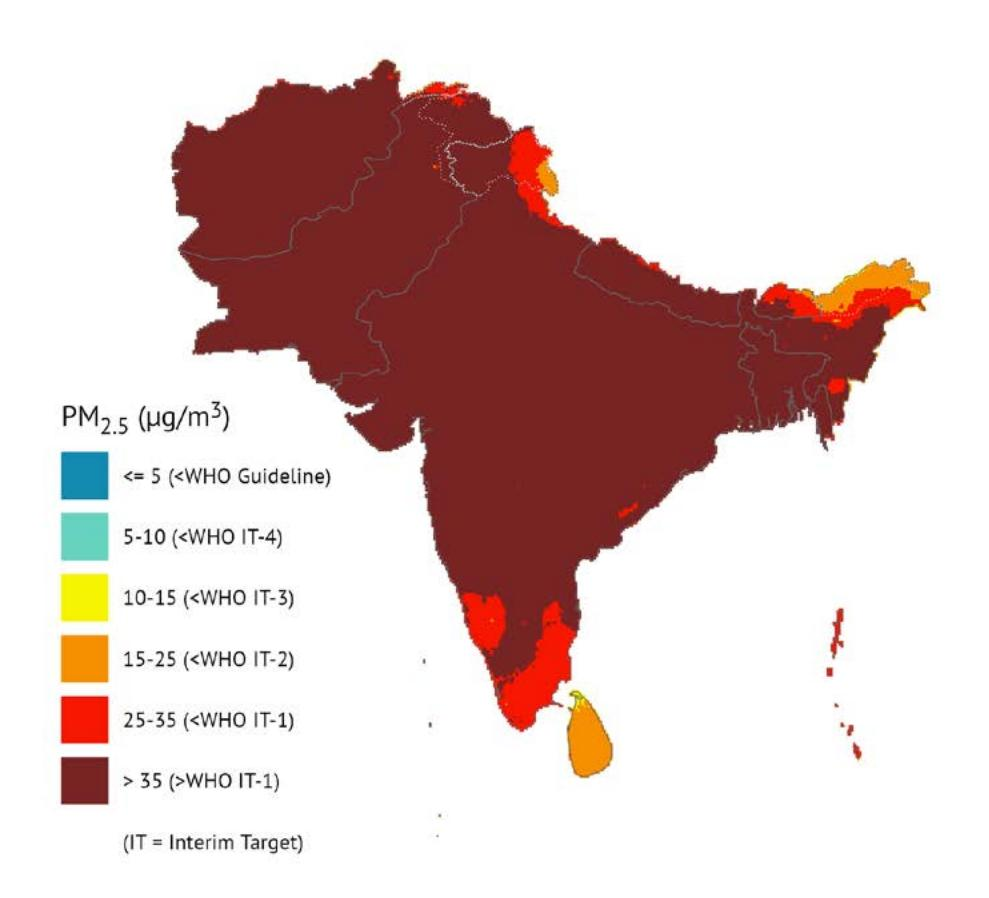
Exhibit 19.1: A Region Under a Cloud of Pollution. This map illustrates the scale of the air quality crisis across South Asia, where a significant portion of the population is exposed to PM2.5 levels that far exceed WHO guidelines, making it one of the most polluted regions on Earth.
It strikes me that while some of us are lucky enough to adapt—to buy air purifiers, monitor air quality apps, or even consider moving to a less polluted area—others don’t have that luxury. They’re exposed to the same harmful air day after day because, for them, work and survival are non-negotiable. It is a jarring reality: the very air that powers our lives in cities is also silently eroding the health of those who keep them running.
A shared crisis across South Asia
In Pakistan, the period between November and February has been colloquially referred to as the fifth season, or the season of smog.1
Year after year, between October to January each year, millions of people across Pakistan, India, Nepal and Bangladesh experience smog-filled skies. The blame shifts between the farmers who burn the agricultural residue, or the urban poor who burn solid fuels for heating or cooking, or better yet, the pollution coming from elsewhere.
Air pollution is the leading environmental risk factor for poor health across South Asia, and levels of air pollutants—especially fine particulate matter (PM2.5)—are often several
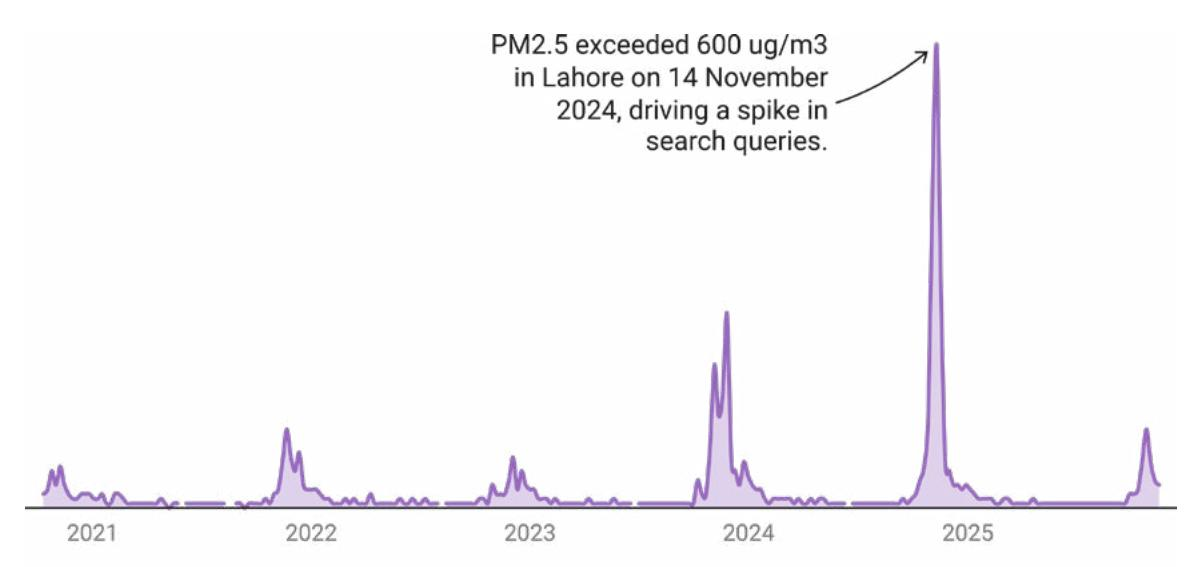
Exhibit 19.2: The Seasonal Spike in Public Interest. This chart of Google search trends for “air quality” in Pakistan reveals a predictable pattern: public attention soars during the visible winter smog season and fades during the rest of the year, even though hazardous pollution is a year-round problem.
fold higher than national air quality standards (Exhibit 19.1). High levels of air pollution have been linked to poor quality of life, and other societal and economic impacts including loss of worker productivity, high healthcare expenditure, reduction in travel and tourism and impact on crop productivity, among other things. Across the region, exposure to air pollution was estimated to cause 2.6 million deaths in 2021, and reduced life expectancy at birth by up to two years.2 The economic impacts are also significant. According to a World Bank estimate, air pollution contributes to 9% of gross domestic product (GDP) equivalent loss in Pakistan.3 In India, poor air quality can cost businesses in India as much as 3% of the total GDP.4
The ‘fifth season’: a cycle of crisis and amnesia
While air pollution is a year-round problem, the issue is often in the public discourse only during the winter months when the effects are often more salient, or visible to the eye. The story is no different in Pakistan where the Google searches for ‘air quality’ tend to peak each winter, with limited activity during other months.
This trend is no different in other South Asian countries, including in India, where air pollution is often in the news cycle during the winter season, and the discourse is often Delhi-centric, despite significant impacts of air pollution on millions of people across northern India. The information is not just anecdotal; an exploratory analysis of English news media articles in India found both a temporal and a geographical bias, indicating that
Exhibit 19.3: Where Unhealthy is the new Normal. The data shows that air quality remains poor across most of South Asia throughout the year with levels of PM2.5 often exceeding 35 µg/m3, the least stringent Interim Target recommended by WHO. Graphic by Shahzad Gani and Pallavi Pant.
media articles were focused on larger cities.5 A larger analysis of media stories across several Asian countries between 2015-2018 also reported a similar trend, with a higher number of media stories during winter months.6
Undoubtedly, the levels of air pollutants including PM2.5 are particularly high during the winter season, but research has shown that air quality remains poor in the region yearround, with levels of PM2.5 often exceeding the least stringent Interim Target (35 µg/m3) recommended by the World Health Organization. Furthermore, in this seasonal discourse, the focus is often placed on immediate, visible sources such as agricultural stubble burning, while not interrogating year-round sources such as waste burning, transportation or energy production. To see measurable progress, however, there is a need for yearround discourse as well as targeted action on air pollution.
The power of a number: making pollution understandable
A key tool for disseminating air quality data and its potential public health implications is
the Air Quality Index (AQI). The AQI translates complex air pollution measurements into a simplified, colour-coded, multi-point numeric scale, specifically designed to indicate the level of health concern posed by local air quality. Higher index values directly correlate with greater air pollution and, consequently, increased health risks. This index typically uses a green-yellow-red colour scheme to denote pollution severity: green generally represents good air quality with minimal health risk, while red signifies higher pollution levels and more significant health concerns. Crucially, AQI values are usually published with health advisories tailored to different pollution levels, offering guidance on reducing exposure and protecting health. For example, in the US AQI system, an index value between 101 and 150 is accompanied by the message:
“Members of sensitive groups may experience health effects. The general public is less likely to be affected.”
The break points and descriptions used to define and describe different AOI categories often vary by country and are based on the national air quality standards and other available health evidence. Countries also include different combinations of air pollutants in estimating the AQI values. For example, in Europe, the European AQI (EAQI) includes PM10, PM2.5, ozone (O2), nitrogen dioxide (NO2), and sulfur dioxide (SO2), whereas in China, 10 addition to the aforementioned pollutants, carbon monoxide (CO) is also included in the calculation of AOI values.
In India, the National Air Quality Index (NAQI) was launched in 2015 and has been used to communicate air quality levels across India; with data publicly available through an app, Sameer, as well as an online data dashboard.7
Pakistan’s Punjab province established its own AQI as part of the Policy on Controlling Smog 2017, and in 2023, revised the AQI cut-off values under the Punjab Clean Air Plan 2023,89
In an increasing number of cities, information about AQI is now routinely included in media reports across print and digital media.
The rise of the citizen scientist
Despite the gaps that remain, there has been progress on air pollution awareness and action in the last decade across South Asia, to which several factors have contributed. In addition to ground monitoring using reference-grade monitors, there are now a plethora of other data sources: low-cost sensors, satellite observations, and simple or sophisticated air quality models. This dynamic, ever-expanding data landscape has enabled in-depth analysis of spatial and temporal patterns of air quality, identification of hotspots, and the opportunity to assess changes in air quality over time. The availability of data, both directly through data dashboards, apps, and websites, and through new research, reports, or publications, has also increased opportunities for print and digital media stories on air
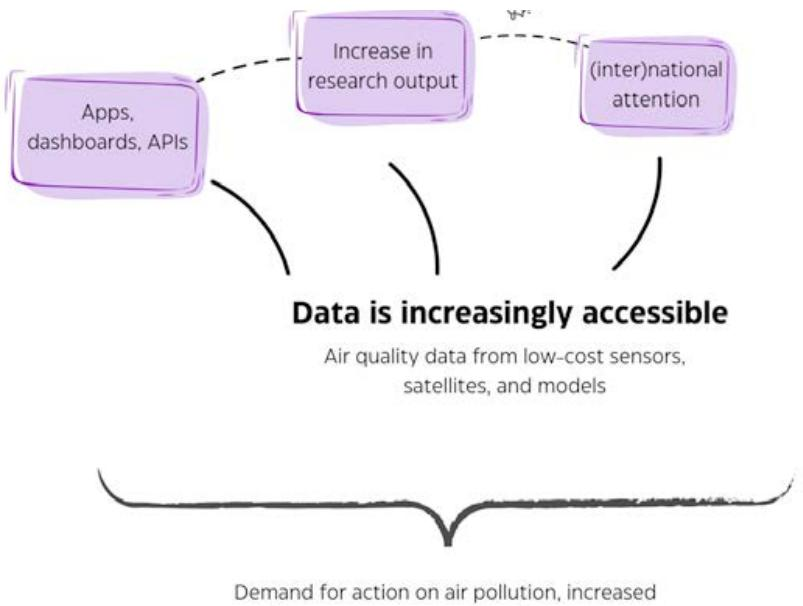
Demand for action on air pollution, increased public awareness, more funding resources
Exhibit 19.4. Accessibility of Air Quality Data Enhances Research, Awareness and Action. As air pollution gains visibility through apps and websites, public awareness and demand for action rise. Data-driven stories and online platforms amplify real-time air quality information, empowering communities to advocate for cleaner air.
quality. In India, for instance, a correlation was reported between availability of air quality data and an increase in media coverage on the topic of air pollution.10
Low-cost sensor technology is increasingly playing a vital role in supplementing traditional air quality monitoring efforts, especially in areas where comprehensive reference-grade networks are limited. Recognising their utility, some local governments have deployed these more accessible sensors to generate initial data on air pollution levels in the absence of reference-grade data. Furthermore, and often in response to gaps in official data availability or accessibility, many civil society organisations and individual citizens have embraced low-cost sensors, utilising them to measure local air quality and foster community-level awareness.
As the issue gains more visibility through news, digital, and social media, public awareness on the issue is also growing. Stories drawing on data and personal experiences related to air pollution are now available widely and create momentum for action. Social media platforms, in particular, amplify real-time air quality data, empowering communities to advocate for change and push policymakers to take action towards cleaner air. An example of the influence of social media can be seen in China where researchers reported that social media exerts a “positive influence on air quality improvement”.11 Collectively, these enablers—community-driven monitoring, the growth of data and research, and the influence of media—are catalysing a societal push towards cleaner air and healthier environments.
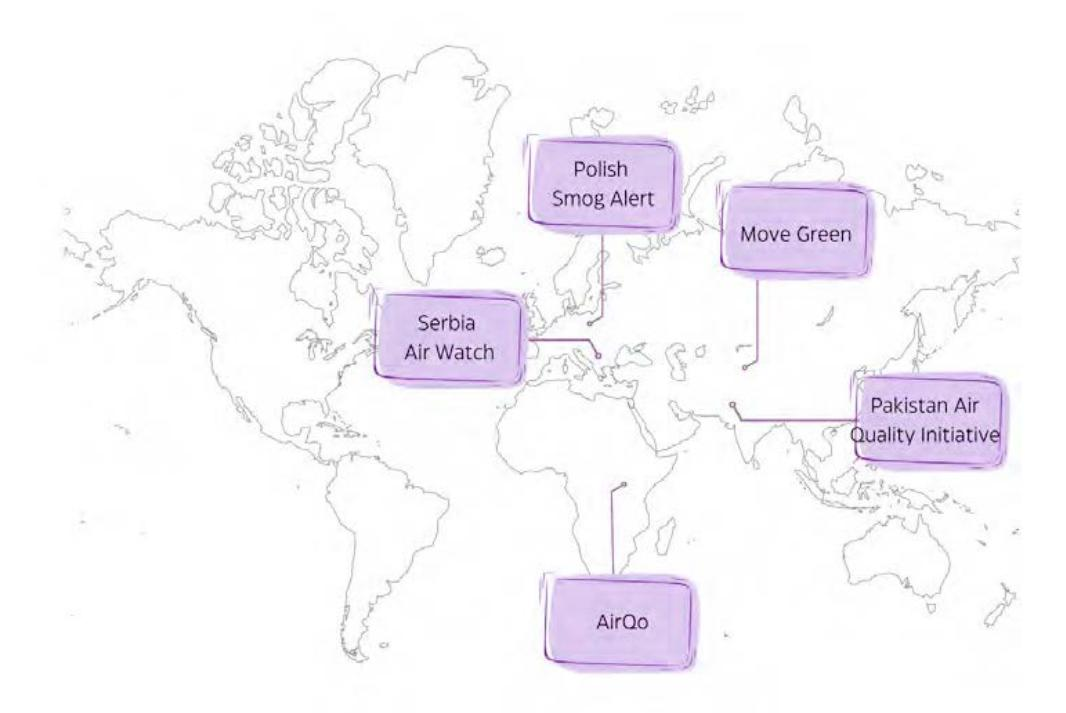
Exhibit 19.5. Citizen Science Monitoring Networks and Groups Around the World That Have Created Impact. Over the past decade, citizen science monitoring networks have made data more accessible, sparking media attention and calls for action.
Stories of change: how data empowers communities
Air quality data is increasingly being used for public engagement and outreach in many cities and countries. In the last decade, there have been multiple inspiring examples where access to data through independent, local citizen science monitoring networks has resulted in increasing public awareness and related media coverage, and ultimately, the need for action. Collectively, the examples below underscore the critical role of accessible, understandable information plays in mobilising effective air quality interventions.
One notable example comes from Bishkek, Kyrgyzstan, where the environmental organisation MoveGreen established AQ.kg—a publicly accessible network of low-cost air quality sensors—to monitor real-time air quality in the capital city and other parts of the country.12 The network’s data is freely available online, and MoveGreen has worked extensively to increase public access to, and understanding of, air pollution data and its profound impacts on health and well-being. MoveGreen was also instrumental in establishing the Central Asia Air Quality Platform, a regional initiative with over 30 members that fosters “constructive partnerships among members of civil society, scientific and academic communities, businesses, media and government agencies to support the clean air movement”.13
Similarly, in Kraków, Poland, a campaign initially launched by a small group of concerned friends—Anna Dworakowska, Andrzej Gula, and Ewa Lutomska—focused on highlighting the severe health effects of local air pollution. This grassroots effort rapidly transformed into the influential Polish Smog Alert initiative.2 15 The work undertaken by the Kraków Smog Alert team not only dramatically raised public awareness about the city’s poor air quality but also directly influenced the municipal government’s landmark decision to ban the use of solid fuels (like coal and wood) in domestic boilers. This policy change, in turn, has led to measurable improvements in the number of good air quality days experienced in the city. The Smog Alert model has since spread to other cities across Poland, and the initiative aims to expand its advocacy work to other central and eastern European countries facing similar challenges.
In Delhi, India, the Mahila Housing Trust undertook an innovative project training women construction workers, who are often disproportionately exposed to pollution, as “AQI Ambassadors”. Equipped with portable air quality monitors and basic training, these women not only monitored local conditions but also effectively raised awareness about air pollution risks within their communities and mobilised local action to address specific pollution sources or advocate for protective measures.
Another example comes from Belgrade, Serbia, where the Belgrade Open School’s project, Serbian Air Watch, installed 50 air quality sensors across five Serbian cities.3 By connecting these sensors to the publicly accessible Luftdaten platform, the project aimed to significantly raise public awareness about local air pollution levels and empower communities with the data needed to advocate for change.
Finally, within Pakistan itself, the Pakistan Air Quality Initiative (PAQI), founded by Abid Omar, has been a leading force in engaging the public on the critical issue of air pollution.17 Starting with just a handful of air quality sensors installed in private homes across major cities like Lahore, Karachi, and Islamabad, PAQI has consistently worked to bring the oftenignored reality of Pakistan’s poor air quality into the public discourse. Through its persistent efforts in data sharing (primarily via social media and its website) and advocacy, the initiative has significantly expanded public access to real-time air quality data and fostered a much broader national conversation about the urgent need for, and opportunities for, clean air action in the country.
The path forward: from data to dialogue
The challenge of air pollution is neither new nor unique to Pakistan. Historical accounts remind us that humans have recognised poor air quality for millennia—as evidenced by Seneca’s relief upon leaving Rome’s “oppressive atmosphere” and “poisonous fumes” in AD 61.18
“No sooner had I left behind the oppressive atmosphere of the city [Rome] and that reek of smoking cookers which pour out, along with clouds of ashes, all the poisonous fumes they’ve accumulated in their interiors whenever they’re started up, then I noticed the change in my condition.”
Throughout history, severe pollution episodes have catalysed meaningful action: London’s Great Smog of 1952, the Los Angeles valley smog crisis of the 1970s, and Beijing’s more recent air quality transformation all demonstrate a consistent pattern: sustainable improvements come through comprehensive, science-based strategies addressing emissions at their source. China’s recent progress offers a compelling model, combining data-driven policies, research investment, and strengthened regulatory capacity across all governance levels.
There is no silver bullet solution for air pollution.
Key sources of air pollution in South Asia include energy production and use, industries, transportation, construction and other dust, waste burning, seasonal sources (such as stubble burning) and those relatively unique to the region (such as brick kilns, tandoors, etc.) collectively contribute to high ambient air pollution.
Residential fuel use, contributing 20-30% to outdoor PM2.5 in many South Asian contexts remains particularly important in regions with limited access to clean energy alternatives, as large proportions of the region’s population lack access to affordable, clean fuels.4
In Pakistan, emissions inventories from the major urban centres identify multiple significant contributors: transportation (approximately 38% of urban PM2.5), industrial activities (around 32%), and brick kilns (about 10%)—with important variations between cities that necessitate locally-tailored approaches.
While the mainstream discourse has focused on air pollution in urban areas in Pakistan and across South Asia, the problem also remains relevant across peri-urban and rural areas. Across the region, transboundary pollution also significantly contributes to elevated pollution levels.
The path towards cleaner air in Pakistan requires leveraging available data and evidence to shape policies and measure progress. Equally important is incorporating the lived experiences of those who suffer the most as a result of air pollution; these perspectives must be considered in decision-making to ensure that policy action is equitable and brings benefits to all.
By combining rigorous technical analysis with community perspectives, Pakistan can develop interventions that deliver cleaner air and better health outcomes for all its citizens. This is how we ensure that a family’s health is no longer determined by their ability to afford an air purifier, but by their right to breathe clean air.
Pallavi Pantis an air quality scientist with 15 years of experience working on air pollution and health, particularly in LMICs. She has contributed extensively to public engagement, capacity strengthening, and science communication, working to increase awareness of air pollution and its health impacts.
Footnotes
-
Zahra-Malik, M. (2017, November 10). In Lahore, Pakistan, Smog Has Become a ‘Fifth Season.’ The New York Times. ↩
-
While this regional pattern holds true in many South Asian contexts, recent Pakistan-specific emissions inventories show significant variation across cities, with residential contributions ranging from just 1% in Karachi to 5% in Peshawar, highlighting the importance of locally-relevant data for effective policy development. ↩